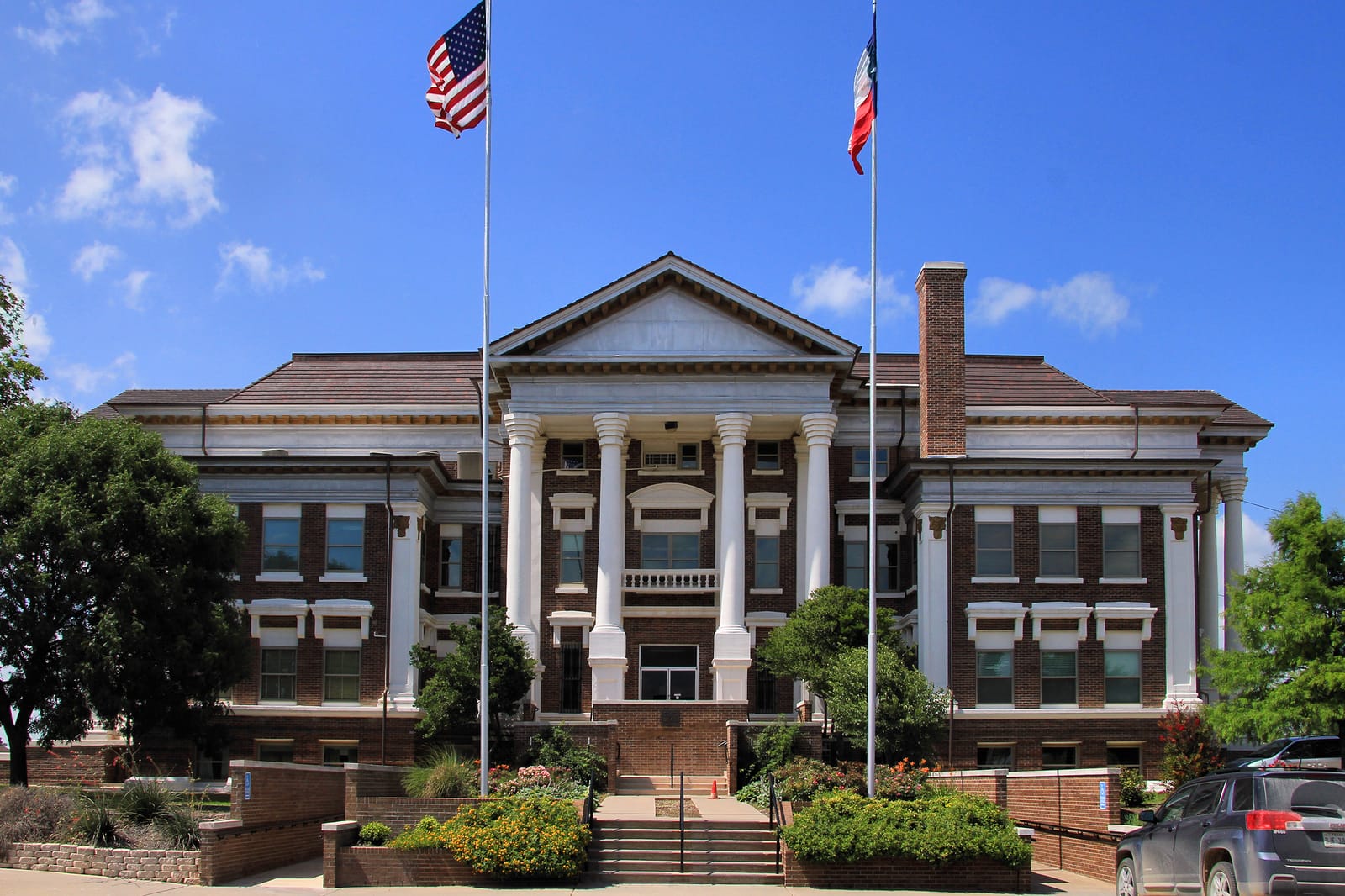
Montague County votes Republican by wide margins, year after year, across virtually every race on the ballot. That pattern is not a recent development; it reflects a political transformation that unfolded over several decades in the second half of the twentieth century and is now complete. To understand how the county governs itself, what issues animate its voters, and how it relates to the broader political landscape of Texas, you need to understand both how that transformation happened and what it produced.
This guide presents the county’s voting patterns, registration data, and civic structure as documented facts — not as arguments for any position.
Presidential Election History
In the 2016, 2020, and 2024 presidential elections, Montague County voted Republican with estimated margins of 70 percent or more in each cycle. The pattern is consistent across Democratic and Republican opponents of different types, across pandemic conditions, and across high- and lower-turnout environments.
Specific precinct-level results for recent elections are available through the Montague County Elections Office and the Texas Secretary of State’s election results database. County-level totals place Montague among a cluster of rural North Texas counties — Cooke, Jack, Young, Archer — with similarly large Republican presidential margins.
For comparison to nearby counties, the gradient runs roughly like this: Montague and similar rural counties vote approximately 78-82% Republican in presidential contests; Wise County, closer to DFW, runs about 72-77%; Denton County, with its university population, runs 55-65%; Tarrant County (Fort Worth) is competitive. Distance from the metropolitan core correlates strongly with Republican margin in this region.
Voter turnout in presidential years runs approximately 65 to 75 percent of registered voters. Off-year and midterm elections bring turnout down to 35 to 45 percent. The 2016 and 2020 cycles generated the highest recent participation.
Registration and Voter Population
Based on Texas Secretary of State registration data and county demographics, Montague County’s registered voter population is estimated at 9,000 to 10,000 (from an adult population of roughly 14,000-15,000). Registration rates around 60-65 percent of eligible adults are typical for rural Texas.
Party registration breakdown is estimated at approximately 65 to 70 percent Republican, 20 to 25 percent Democratic, and 5 to 10 percent independent or other. Texas does not require voters to register by party; these estimates are derived from voter self-identification data, historical voting patterns, and county demographic composition.
Statewide Races and Consistent Patterns
Since approximately 1994, Montague County has voted Republican in gubernatorial races (Bush 1994, Perry 2002-2010, Abbott 2014-2022), U.S. Senate races, and all statewide constitutional officer contests. The county maintained this pattern through the 2018 “blue wave” cycle that saw increased Democratic performance in suburban Texas, and through the 2022 cycle. Statewide Republican candidates reliably carry the county.
Local school board elections, city council races, and municipal elections are formally nonpartisan in Texas. In practice, candidates in Montague County tend to reflect the county’s dominant political culture. No county-level offices have been held by Democrats in recent cycles.
County Government Structure
Montague County operates under the Texas Commissioner Court model: a County Judge and four County Commissioners, each representing a precinct, make up the governing body. The County Judge presides over the court and also has judicial responsibilities. Other elected county officials include the Sheriff, County Clerk, District Clerk, Tax Assessor-Collector, County Attorney, and four Justices of the Peace.
All current county elected officials are Republican. The full roster is maintained at the Montague County official website and the Montague County Republican Party elected officials directory.
The six independent school districts — Bowie, Nocona, Saint Jo, Forestburg, Gold-Burg, and Prairie Valley — hold nonpartisan school board elections. Boards are community-oriented and locally focused.
The Realignment: From Democratic to Republican
Montague County, like all of rural Texas, was solidly Democratic from the end of Reconstruction through the 1960s. The Democratic Party’s hold on rural Texas was rooted in anti-Reconstruction sentiment, agrarian populism, and skepticism of federal power — a coalition that held for a century.
The shift began in earnest in the 1960s and accelerated through the 1980s and 1990s. The proximate drivers were national: the 1964 Civil Rights Act and 1965 Voting Rights Act registered by many rural white voters as federal overreach; the 1973 Roe v. Wade decision mobilizing religious conservatives toward the Republican Party; Nixon’s “Southern Strategy” in the 1970s; the alignment of evangelical Christianity with Republican social conservatism through the 1970s and 1980s; and Fox News’s 1996 launch accelerating conservative media consolidation.
By the time George W. Bush ran for governor in 1994, the realignment in rural North Texas was effectively complete. Montague County has been reliably Republican in every meaningful contest since.
The realignment is documented in the Texas Election Almanac and in historical county election records. It was not unique to Montague County; the same shift occurred across rural Texas, rural Oklahoma, and rural states throughout the South and Great Plains over roughly the same period.
Issue Priorities
Research on rural Texas voting preferences identifies the following issues as most salient to Montague County voters, based on polling, county fair conversations, church community discussions, and regional survey data:
Core priorities: immigration and border security; inflation and cost of living; energy policy (directly connected to the county’s oil and gas production and landowner royalty economics); gun rights and Second Amendment; property rights and agricultural land ownership.
Secondary priorities: school choice and parental rights in education; abortion and family values (religious conservative base); water rights and rural development; agricultural subsidies and farm policy; wildfire prevention and land management; rural broadband access.
Lower-salience issues in this county specifically include urban transit, housing density, climate policy, and foreign policy — not absent from the public conversation, but typically not decisive in local electoral outcomes.
Political Organizations
The Montague County Republican Party (montaguegop.org) is the county’s primary political organization. Activities include candidate recruitment, voter outreach, phone banking, representation at the state convention, and advocacy on property rights, gun rights, and immigration enforcement issues. A Democratic organization exists but has limited infrastructure and membership in the current environment.
The Tea Party movement (2009-2016) had moderate local activity, aligned with limited-government and gun-rights themes. Post-2016, Trump-aligned organizations merged into mainstream Republican precinct operations.
Non-partisan civic organizations — chambers of commerce in Bowie, Nocona, and Saint Jo; the County Farm Bureau; volunteer fire departments; churches; 4-H and FFA chapters — represent the county’s civic infrastructure outside partisan politics.
Precinct Geography
Montague County typically contains four commissioner precincts (matching county commissioner districts) plus multiple election precincts within incorporated towns. Unlike urban counties with dramatic geographic variation between precincts, Montague County shows relatively homogeneous voting across its geography. No precinct reliably produces Democratic majorities; the split between incorporated towns and rural unincorporated areas is estimated at roughly 25% Democratic in towns versus 18% in rural precincts — a modest difference that has not affected overall county results.
Context in Rural Texas
Montague County’s political character is representative of, rather than exceptional among, rural North Texas counties. The combination of strong Republican registration, large presidential margins, consistent down-ballot Republican voting, energy-economy alignment with pro-production policy, agricultural property rights concerns, and social conservatism rooted in evangelical Protestantism describes a broad region stretching from the Red River counties south to the Hill Country.
The county’s political trajectory over the next decade will likely be shaped by the same forces affecting rural Texas generally: whether the DFW exurban expansion and ranchette buyer influx brings demographic change, whether energy policy debates intensify around the county’s oil production, and whether school consolidation pressures and rural broadband gaps affect quality-of-life perceptions that shape long-term residential stability.
Voting data from Texas Secretary of State election results and Montague County Elections Office. Registration estimates from Texas SOS historical data and county demographics. Issue priorities based on Pew Research Center, AP-VoteCast, and Texas Tribune rural polling. For specific recent election totals, contact the Montague County Elections Office (940-894-2540) or visit co.montague.tx.us.
Related guides: Workforce and Commuting Patterns · Oil and Gas in Montague County Today