Montague County’s 2,109 Hispanic and Latino residents make up 10.6% of the county population — a proportion that has grown steadily from 7.3% in 1990, reflecting four decades of gradual demographic change in a county that remains predominantly Anglo-American. The community is multi-generational, long-settled, and deeply integrated into the county’s agricultural, manufacturing, and service economy.
Understanding this community requires two threads: the historical one, which reaches back to the vaquero trail hands of the Chisholm Trail era, and the contemporary one, rooted in census data and lived community experience.
What the Numbers Show
According to the ACS 5-year estimates (2020-2024), Montague County’s Hispanic and Latino population stands at 2,109 persons (MOE ±323), representing 10.6% of the county’s 19,847 total population. The 2020 Decennial Census recorded 2,088 Hispanic residents (10.4% of 20,121).
Of the Hispanic population:
- Approximately 69.5% are US-born — the majority are American citizens by birth, many with multi-generational Texas roots
- 1,912 persons (9.6%) speak Spanish at home, consistent with the overall Hispanic population count
- 643 persons (3.2%) of the total county population are foreign-born, suggesting the Hispanic community includes long-term residents with deep local connections
The county’s Hispanic population has grown approximately 44% over 34 years — from roughly 1,487 persons in 1990 to 2,109 in 2024. This growth occurs within a county whose total population has been essentially flat over the same period, meaning Hispanic residents represent a growing share of a stable-sized county.
The Vaquero Heritage
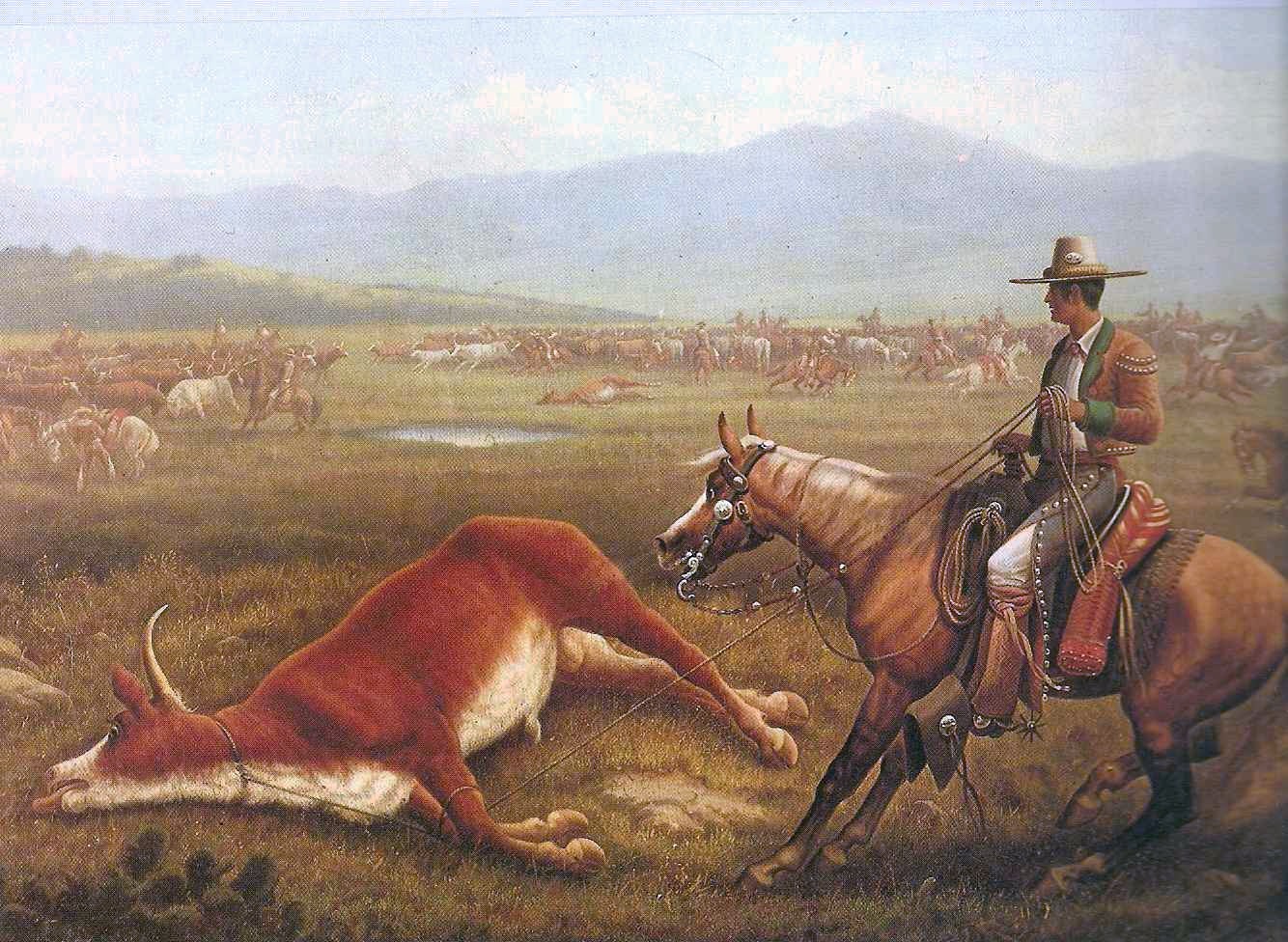
Long before census data documented Hispanic presence in Montague County, Spanish-speaking ranch hands called vaqueros were central to the cattle economy that defined the region. The Chisholm Trail crossed Montague County at Red River Station from 1867 through the early 1880s, and the crews that drove those millions of longhorns north carried the technical knowledge and vocabulary of vaquero tradition.
Every drive crew assembled in south Texas — where vaquero labor was concentrated — and an estimated one to three Mexican and Tejano vaqueros per crew worked each outfit that crossed the Red River. The complete technical system of the American cattle drive had Spanish-Mexican origins:
- Lariat — from la reata (the rope)
- Remuda — from the Spanish word for the herd of horses worked in rotation
- Corral — from Spanish corral (enclosure)
- Cinch — from cincha (saddle girth)
- Chaps — from chaparreras (leather leg protection)
- Buckaroo — from vaquero itself, anglicized through oral transmission
These words entered the language of north Texas ranching and stayed. The vaqueros who passed through Montague County contributed both their labor and the vocabulary that Anglo cowboys adopted as their own.
The historical documentation of individual vaquero names, families, and stories from the Chisholm Trail era in Montague County has not been completed. The aggregate evidence — workforce percentages, vocabulary transmission, documented south Texas recruitment patterns — is well-established in Chisholm Trail scholarship. The specific men who crossed at Red River Station are largely unnamed in surviving records. The UNT Special Collections (Nocona Boot records and Hispanic community oral history) and the Montague County Clerk’s marriage and deed records from the 1880s–1920s are the most promising sources for surfacing family names and settlement patterns — research that has not yet been conducted.
For the full cattle-drive story, see The Chisholm Trail in Montague County.
Today’s Community
Montague County’s contemporary Hispanic community is concentrated in:
- Agricultural and ranching work — consistent with north Texas rural patterns; construction, livestock, and crop operations
- Manufacturing — Justin Boots (now operating as Lucchese) and related leather-goods employment
- Healthcare support roles — 12.2% of employed MoCo residents work in healthcare and social assistance
- Service sector — food service, cleaning, and maintenance industries
Spanish is spoken in an estimated 1,912 households (9.6% of county population). Limited English proficiency — residents who speak English less than “very well” — affects approximately 3.5% of the county population, well below the Texas state average of approximately 10%, reflecting the long-term settlement and second-and-third-generation English dominance in most Hispanic MoCo families.
Research Resources for Hispanic Family History
If you are researching Hispanic family history in Montague County, the following sources are the most accessible:
Online:
- FamilySearch (familysearch.org) — Census manuscripts 1860–1940, marriage records, land surveys available free with account
- UNT Portal to Texas History (texashistory.unt.edu) — Montague County Area Newspaper Collection (MCANC) with 150+ issues of local newspapers 1871–present; searchable digitized text
- Baylor Institute for Oral History (digitalcollections-baylor.quartexcollections.com) — 7,800+ Texas oral history interviews; some may include north Texas Hispanic community voices
In-person (visit required):
- Bowie Public Library, Local History Room — 301 Walnut St, Bowie, TX 76230; Mon/Sat 10am–2pm; 940-872-2681
- Montague County Clerk’s Office — deed records, marriage licenses, naturalization records
- Diocese of Fort Worth Archives — sacramental records (baptism, marriage, death) for all Catholic parishes in Montague County; written request required, four-to-eight-week lead time
What to look for:
- County deed records from 1870s–1920s for land ownership by Hispanic-surnamed families
- Marriage and birth records for family genealogy reconstruction
- Sacred Heart Catholic Church (Saint Jo) parish records documenting Hispanic Catholic families
Sources: US Census Bureau ACS 5-Year Estimates 2020-2024, Table B03003 (Hispanic population 2,109, 10.6%); 2020 Decennial Census (2,088 Hispanic, 10.4% of 20,121 total); Texas State Historical Association, “Chisholm Trail” (tshaonline.org).