Before the cotton gins arrived, before the KMA oilfield, before the railroads reshaped the county’s economy, Montague County was a transit zone for one of the largest livestock movements in human history. For roughly eighteen years — from the late 1860s through the early 1880s — millions of Texas longhorns crossed Montague County’s Red River at a crossing called Red River Station, bound for Kansas railheads on what became known as the Chisholm Trail. That era lasted less than two decades, but its mark on county identity, on the towns that rose and declined along the route, and on the cultural mythology of north Texas endures well past the last drive.
The Trail Enters Montague County
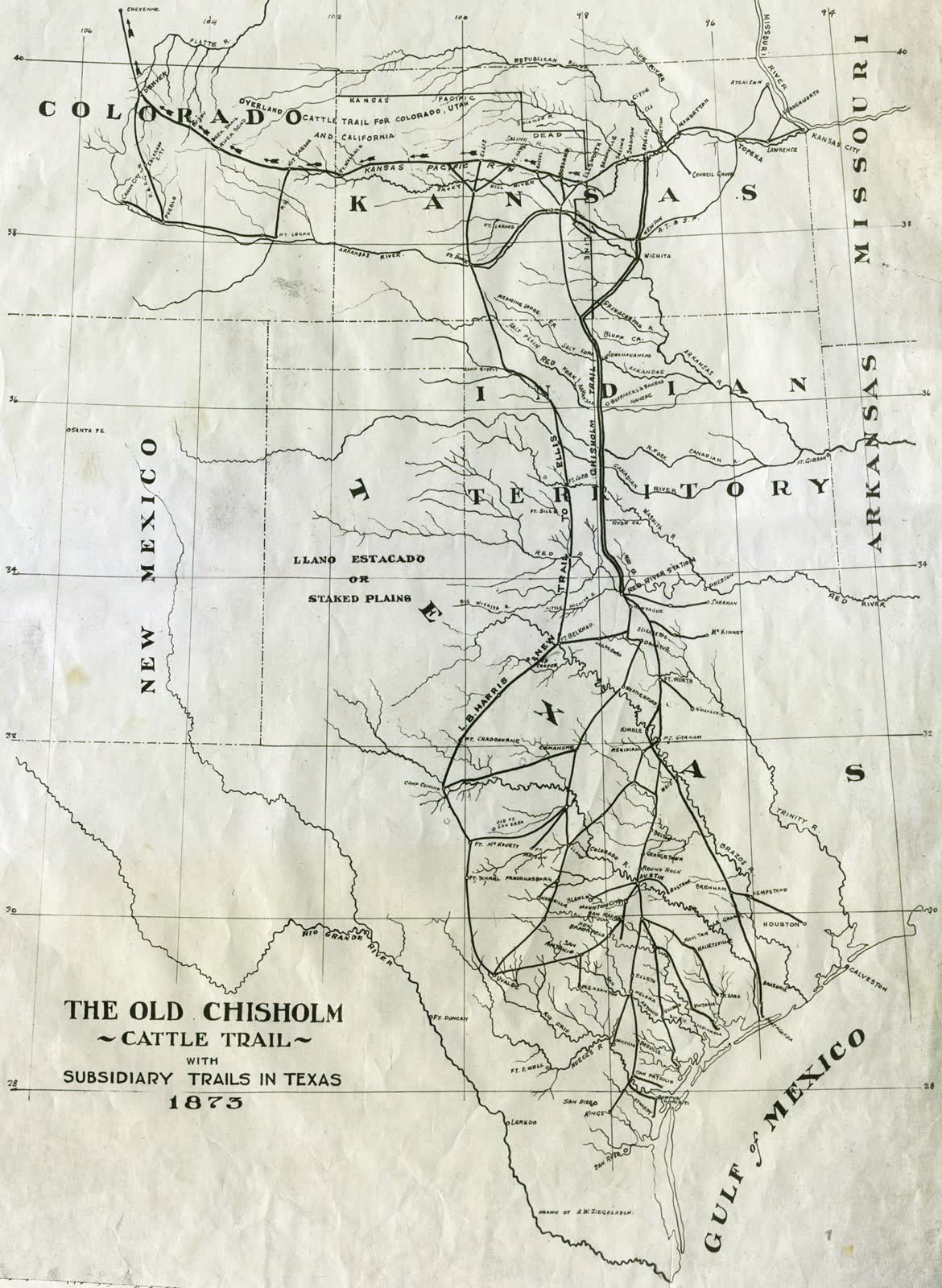
The Chisholm Trail took its name from Jesse Chisholm (1805–1868), a Cherokee-Scottish trader who established a wagon route from south-central Kansas into Indian Territory in 1864. Chisholm’s original route became the framework Texas cattlemen extended southward after the Civil War, connecting the enormous post-war cattle surpluses in Texas with the booming demand of Eastern markets accessible by Kansas railroads. The Kansas Pacific reached Abilene in 1867, providing the first viable railhead; within months, the trail became the backbone of the Texas cattle economy.
The trail’s approach to Montague County came through the prairie corridors between the Eastern and Western Cross Timbers — the narrow bands of post-oak woodland that mark the transition from the open plains to the east Texas timber country. Cattle drives moving north from south and central Texas followed the natural grass corridors, routing through what are now Cooke and Montague counties toward the Red River. The specific crossing that anchored MoCo’s role was Red River Station, situated in the county’s northwestern quarter, approximately nine miles from what is now Nocona.
The ford at Red River Station worked for the same reasons that geography dictated most river crossings: a sandy bottom that gave cattle and horses purchase, manageable bank approaches without the bottleneck of steep bluffs, and an open enough floodplain on the Texas side that a herd of three thousand head could stage on the south bank while the advance cattle were already swimming. The practical calculus of moving large herds made this crossing decisive. When water was too high for fording, a ferry operated from the south bank — charging per head and per person at market rates.
Red River Station: The Crossing Town
At peak drive season, Red River Station supported 250–300 residents — a substantial concentration for north Texas in the 1860s and 1870s. The town’s economy was trail-drive commerce: saloons, supply stores, livery operations, ferrying services. The crossing processed dozens of herds during the March-through-August drive season, each herd typically carrying 1,500–3,500 head and a crew of ten to fifteen men who had been on the trail for sixty to ninety days from south Texas.
The social character of Red River Station was that of a trail crossing town: episodically crowded, economically active during drive season, and quieter in winter. The commercial infrastructure catered to drovers who needed resupply, ferry service, and somewhere to sleep before the more uncertain crossing of Indian Territory to the north. Trail bosses settled accounts here. Cattle buyers sometimes positioned themselves at the crossing. Ferrymen, saloon operators, and livery keepers extracted their portion of the value flowing through.
The names and labor of most of the people who worked those crossings — the cowboys who swam the cattle, the vaqueros who managed the remuda, the African American trail hands estimated at twenty-five percent or more of the total trail workforce — do not survive in the documentary record. What survives is the bale-count equivalent: the aggregate number of cattle, not the names of the people who moved them.
Saint Jo: The Trail Town That Lasted
Fifteen miles south of the Red River crossing, Saint Jo emerged as the most durable MoCo trail town of the era. The Stonewall Saloon, named for Confederate General Stonewall Jackson, was built in 1873 and became a recognized drover stop on the trail. By 1890, Saint Jo’s population had reached approximately 1,000 — substantial growth from the frontier-era baseline — driven by trail commerce, supply operations, and the secondary economy that serviced both cattle outfits and the settlers coming into the county.
The Stonewall Saloon’s trail-era reputation placed Saint Jo on the mental map of drovers who came through annually. The saloon served not just as a drinking establishment but as an information exchange — trail bosses shared crossing conditions, cattle prices at Kansas railheads, and news from south Texas. The building still stands today as the Stonewall Saloon Museum, one of MoCo’s most tangible connections to the cattle-drive era.
Saint Jo’s position, unlike Red River Station’s, was not dependent entirely on trail traffic. The community had agricultural land, water, and position at the edge of the Cross Timbers that made it viable after the drives ended. Red River Station’s population dispersed; Saint Jo’s persisted, adapting to the railroad-and-cotton economy that followed the trail era.
Cattle-Drive Culture: Who Drove the Longhorns
The popular mythology of the cattle drive centers on the Anglo cowboy, and that figure was real — Anglo-Texan drovers were numerically dominant in most trail outfits. But the actual workforce was substantially more diverse.
African American cowboys are documented at an estimated twenty-five percent or more of the trail-era labor force, per the Texas State Historical Association. Freed from enslavement after the Civil War, Black Texans formed a significant portion of the post-war labor pool that the cattle industry recruited. Their technical skill and their contribution to the trail drives are a documented historical reality, though one underrepresented in the mythology that subsequent generations inherited.
Mexican and Tejano vaqueros contributed a dimension that goes deeper than numbers: the complete technical system of the American cattle drive was of Spanish-Mexican origin. The rope technique, the saddle design, the remuda management, the branding practice, the roundup organization — the entire practical vocabulary of trail-era cowboy work was developed by vaqueros working the ranches of New Spain and south Texas over three centuries before the first Chisholm Trail drive. The very words tell the story: lariat from la reata; remuda from the Spanish; corral, cinch, chaps (from chaparreras), buckaroo from vaquero itself. Trail crews assembling in south Texas, where vaquero labor was concentrated, carried that workforce with them to the Red River crossing.
A typical drive employed one trail boss, eight to twelve cowboys, a cook, and a wrangler. The daily routine was governed by the herd: pre-dawn start, fifteen miles on a good day, evening beddown, rotating night watch to prevent stampedes. River crossings were the most dangerous points — quicksand, swift current, and cattle that panicked mid-river could scatter a herd or drown men. Lightning, drought, and the occasional rustler rounded out the hazards of a drive that could take three months from south Texas to Kansas.
Cowboy wages ran $25–$30 per month, collected at the end of the drive in Kansas, where trail towns like Abilene, Wichita, and Dodge City took their share before the drovers headed south again.
The End of the Trail Era
The Chisholm Trail closed under converging pressures that arrived fast enough to transform the county’s economy within a single decade.
Railroads ended the economic need for trail drives. The Fort Worth and Denver Railway reached Bowie in 1882, giving Montague County direct rail access to eastern markets. Cattle could be loaded on rail cars in Texas rather than driven north for months. The driving economy became obsolete almost immediately.
Kansas quarantine laws restricted Texas cattle. Texas longhorns carried tick fever to which Kansas livestock had no resistance. As Kansas farmers’ cattle died from exposure, quarantine lines were extended further westward, ultimately closing the trail from the east and center before barbed wire and railroads completed the closure.
Barbed wire subdivided the open range. Patented in 1874 and widespread by 1880, barbed wire transformed the Cross Timbers and Grand Prairie into fenced ranches. The free trail corridors that had carried millions of cattle north were cut, rerouted, and eventually eliminated.
By 1884, the Chisholm Trail era was over in Montague County. The drives had lasted eighteen years. Red River Station’s trail economy dispersed. The county’s population began the next transformation — from cattle-drive transit zone to cotton-farming territory — that would define the following three decades.
The Trail’s Lasting Mark
The Chisholm Trail’s eighteen-year run left marks on Montague County that persist well past the drives themselves. Saint Jo’s Stonewall Saloon Museum preserves the trail town’s physical presence. Historical markers trace the route through the county. The Tales ‘N’ Trails Museum in Bowie carries Western Heritage exhibits connecting MoCo’s cattle-drive era to the broader regional story.
More broadly, the trail era established Montague County’s entry into the national-scale economy — not yet through agriculture or industry, but as a transit zone for the beef supply chain of post-Civil War America. The crossing at Red River Station and the trail town at Saint Jo were, for those eighteen years, nodes in a continent-spanning commercial network. The mythology that has attached to the cattle drive era — the cowboy iconography, the trail-town romance, the longhorn as Texas symbol — grew from this period and this geography as much as from anywhere else in north Texas.
Related pages: Red River Station History · Saint Jo · Major Historic Ranches of Montague County · Cattle-Cotton-Oil Era Index
Sources: TSHA Handbook of Texas (Chisholm Trail, Saint Jo, Red River Station entries); U.S. Bureau of Statistics trail-volume figures as cited by TSHA; red-river-station.md node file; st-jo.md node file; chisholm-trail.md research file. Vaquero labor dimension sourced to Neil Foley, The White Scourge (2000) and David Montejano, Anglos and Mexicans in the Making of Texas (1987); individual vaquero names crossing Red River Station have not been documented and require Diocese of Fort Worth sacramental records research to recover.