Montague County’s ranching heritage begins not as backdrop but as the economic reason the county exists. The county was organized in 1858, just as the first cattle operations were taking hold in its southern reaches. By 1873, when David Crockett Jordan and William Broaddus drove fifteen thousand head into north-central MoCo, the county’s identity as cattle country was already established in outline and about to be confirmed in fact.
The named historic ranches documented here are confirmed through verifiable sources. The documentation is uneven — the Jordan-Broaddus operation is exceptionally well recorded by north Texas standards; most other MoCo ranches survive in outline only. Where primary evidence exists, it is recorded in full. Where claims would require fabrication to complete, the gaps are acknowledged explicitly.
Who Were the First Cattle Operators in Montague County?
The earliest documented cattle operations in Montague County cluster around Forestburg, in the county’s southern tier, where a band of early settlers established ranching enterprises in the early 1850s. The principal names preserved in the TSHA Handbook of Texas entry for Forestburg are Austin Perryman, Wash Williams, and Bob Clark — three cattlemen who represent the first generation of Anglo ranching enterprise in southern MoCo.
Their arrival preceded the county’s formal organization by several years and placed them in genuinely dangerous territory. The Comanche raiding lanes that ran south from Indian Territory across the Red River into north Texas were among the most active in the region during this period, and the Forestburg area — in the rolling Cross Timbers zone of the southern county — was directly exposed to raiding parties moving along the interior corridors. The ranching effort in the Forestburg district was accordingly a stop-and-start enterprise: settlers established claims, were driven out by raids, returned when conditions improved, and were driven out again.
The specific acreages Perryman, Williams, and Clark operated are not preserved in available sources. What the TSHA record confirms is that these three were the named founders of the Forestburg settlement’s cattle enterprise — the first people to attempt a ranching livelihood in that part of the county. Their persistence through the violent 1860s, when Comanche raids reached peak intensity in north Texas, established the territorial claim that later settlers consolidated after the frontier stabilized following 1875.
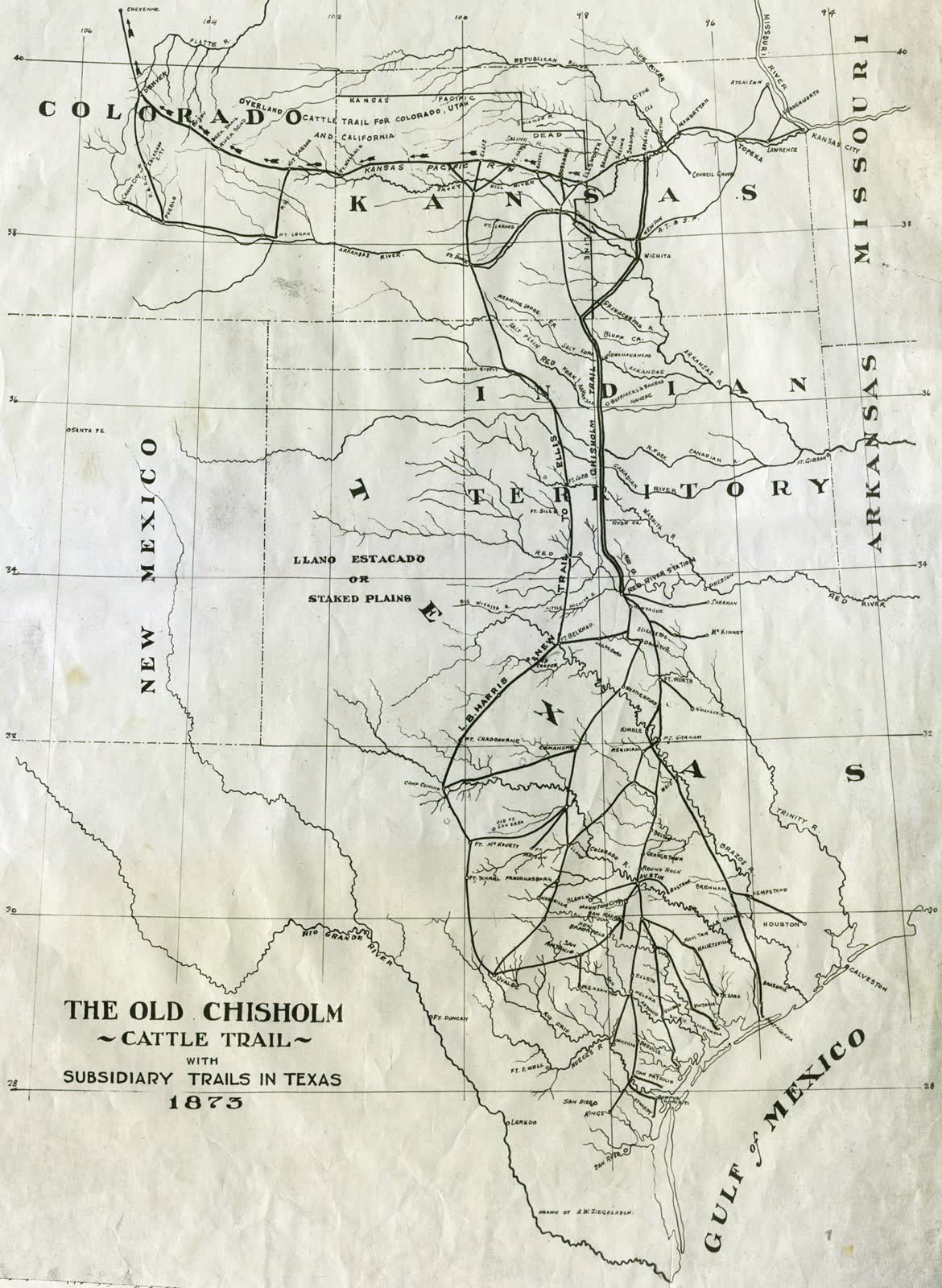
Connection to the Chisholm Trail: The Forestburg district’s earliest cattle operations preceded the Chisholm Trail by more than a decade. When the trail opened in 1866–1867 and drives began moving north through MoCo toward the Red River crossings in the county’s northwest, the southern county’s established operations supplied some of the cattle that joined the trail stream.
What Was the Jordan-Broaddus Ranch?
No documented ranch operation in Montague County approaches the scale or historical specificity of the operation that David Crockett Jordan and William Broaddus established beginning in 1873. It is the most completely verified cattle enterprise in the county’s pre-railroad history.
Jordan (1842–1902) and Broaddus (1828–1895) arrived in Montague County in 1873 with an estimated 15,000 head of cattle — a drive of extraordinary scale for the period. Broaddus, the senior partner by age, brought a cattleman’s background; Jordan, a Kentucky-born Confederate veteran of the 5th Regiment Kentucky Mounted Infantry, had spent post-war years building his north Texas ranching experience. The TSHA Handbook of Texas entry for Nocona, Texas, confirms the partnership, the cattle count, and the general location of the ranch headquarters in north-central Montague County. Both partners are buried at the Nocona Cemetery, designated Area Pioneers.
The ranch headquarters sat in a corridor of north-central MoCo where ridges and creek drainages provided good grass cover and water access. By 1881, Broaddus and Jordan had accumulated approximately 20,000 acres of Montague County grassland — confirmed through the Nocona TSHA entry and consistent with their subsequent leverage in railroad negotiations. In the context of north Texas cattle ranching before barbed wire reorganized the landscape, 20,000 deeded acres alongside open-range grazing rights represented genuine accumulated capital.
The Jordan-Broaddus operation straddled the two great eras of north Texas ranching. When the partners arrived in 1873, the Chisholm Trail was at or near peak activity. Their operation functioned as a settled ranch supplying the regional cattle economy rather than as a trail-drive assembler. As the trail wound down after 1880 — the Fort Worth and Denver Railway reached Bowie in 1882, providing a Texas railhead and eliminating the need for the long Kansas drives — the partnership was positioned to pivot.
That pivot came in 1887, when surveyors for the Gainesville, Henrietta and Western Railway (chartered July 23, 1886, and by January 1887 sold to the Missouri, Kansas and Texas Railroad) were routing a line across Montague County. Jordan traveled to negotiate with MKT officials and persuaded the line to cross his land. In exchange, Jordan and Broaddus deeded 40 acres for right-of-way and Jordan donated a full section (640 acres) of their 20,000-acre ranch for the new townsite. The town first named Jordanville — and shortly renamed Nocona on the suggestion of a Texas Ranger, in memory of Comanche chief Peta Nocona — was platted on what had been the heart of the ranch.
The conversion of 640 acres of working ranch land into a railroad town was a strategy, not a sacrifice. Jordan went on to serve as Montague County Commissioner, Justice of the Peace, and president of the Nocona National Bank. The Jordan-Broaddus operation is the most significant documented ranch in Montague County history by any measure: scale, historical specificity, and subsequent civic consequence.
What Was the Suggs Ranch Near Bowie?
A second confirmed historic MoCo ranch operation emerges from the biographical record of a nationally prominent Texas ranching figure. Jay Taylor — who became president of the American National Cattlemen’s Association in 1954 — was born on January 24, 1902, on the Suggs Ranch near Bowie, Montague County. His father, Jay Littleton Taylor, was employed there as wagon boss at the time. This detail is preserved in the TSHA Handbook of Texas entry for Jay Taylor and represents confirmed evidence of a named historic ranch in the Bowie area with active operations in the early twentieth century.
A wagon boss was a supervisory ranch position, overseeing crews during roundup and driving operations. The presence of a named wagon boss with family quarters at the Suggs Ranch in 1902 indicates a going commercial operation of meaningful scale. The founding date, acreage, and owner identity of the Suggs Ranch are not preserved in available sources — the TSHA entry names the ranch only in the context of Jay Littleton Taylor’s employment — making this a partial but confirmed record.
The Suggs Ranch, operating in the Bowie area in 1902 with a full wagon-boss setup, was part of the post-Chisholm Trail enclosed-ranching economy. Barbed wire had reorganized the county by that point; the railroad had been in Bowie since 1882; local auctions and rail shipping had replaced the long Kansas drives. Whatever its acreage, the Suggs Ranch was operating in a fully enclosed, rail-served north Texas landscape.
What Is Known About the Worsham Ranch?
The Worsham Ranch is the most persistently named historic ranch in MoCo regional sources, though its documentation is thinner than the Jordan-Broaddus or Suggs entries. The operation is located near the Clay County–Montague County boundary — the operation straddled southeastern Clay County and southwestern Montague County — and appears to have been one of the major cattle operations in that sector across the late nineteenth and early twentieth centuries.
The Worsham Ranch appears in available sources in connection with an oil discovery in the 1930s, when petroleum production reached parts of MoCo associated with the KMA Field developments that had begun in 1931. A working ranch also serving as a petroleum prospect was a common pattern among large north Texas ranches that survived the cotton era by diversifying into mineral royalties.
The specific founding date, acreage, and Worsham family biography are not confirmed in available sources. The ranch is named in enough regional contexts to warrant inclusion here, but the claims that can honestly be made at this research stage are limited to: the ranch existed in the Clay County–MoCo boundary area, it was significant enough to appear in regional ranch-and-oil history, and the family retained land connection across generations. Detailed Worsham Ranch history is a primary outstanding research gap.
Spanish Fort and the Cattle Trade Infrastructure
The community of Spanish Fort, in northern Montague County on the Red River, provided an alternative crossing and supply infrastructure for the cattle trade during the Chisholm Trail era. The documented presence that anchors Spanish Fort’s cattle-era significance is H.J. Justin’s bootmaking shop, established there in 1879 specifically to serve the cowboy trade. Justin’s decision to locate at Spanish Fort — placing his shop at the junction of the county’s ranching infrastructure and the trail commerce — reflects where the working cattle economy of northern MoCo was concentrated at that moment.
The individual ranch operations in the Spanish Fort area — the tracts whose cattle moved north through the Spanish Fort crossing or grazed the rangeland between Spanish Fort and Red River Station — are not named in available sources. County deed records and brand registration books held at the Montague County Clerk’s office are the designated sources for recovering those names.
How Did Open-Range Give Way to Enclosed Ranching?
The named ranches documented above all span the transition from open-range to enclosed ranching, which reshaped the county’s land use between approximately 1874 and 1890.
Under open-range conditions, cattle from multiple operations mingled across the county’s grassland. Spring roundups, organized cooperatively by area ranchers, were the primary mechanism for separating stock, branding calves, and identifying market animals. The Jordan-Broaddus partnership participated in this system across its 1873–1887 operating period; the Forestburg-area ranches of Perryman, Williams, and Clark operated on the same principles.
Barbed wire, patented in 1874 by Joseph Glidden, arrived in MoCo through the mid-to-late 1870s and early 1880s. Its adoption was contentious: the Texas Fence-Cutting Wars peaked in 1883 across north Texas as open-range operators cut newcomers’ fences, and the Texas legislature criminalized fence-cutting in 1884. The Fort Worth and Denver Railway reaching Bowie in 1882 eliminated the economic rationale for the long Kansas drives. The convergence of barbed wire, railroad access, and declining trail economics compressed the open-range-to-enclosed-ranch transition into roughly a decade.
For the Jordan-Broaddus operation, this transition coincided exactly with their railroad negotiation: by 1887, when they were deeding land for the Nocona townsite, the open-range era was effectively over and their 20,000 acres had become a bounded property in a fenced landscape.
What Is the Long-Term Legacy?
The ranches documented above did not simply end with the close of the nineteenth century. The Suggs Ranch was actively staffed through 1902. The Worsham Ranch persisted through the oil-discovery era of the 1930s. The families of the county’s earliest ranchers — the Perrymans, the Broaddus and Jordan descendants — remained part of Montague County’s social fabric through subsequent generations.
The cotton boom of the 1880s through 1910s displaced some ranching land to row crops, particularly in the county’s more workable southern soils. The boll weevil crisis from 1910 onward reversed some of that conversion. Drought cycles — the 1930s Dust Bowl, the severe 1950s drought — consolidated ranch holdings as marginal operators failed and survivors absorbed additional acreage.
The modern Montague County cattle economy — 73,289 head, 1,644 farms and ranches averaging 283 acres, livestock representing 81% of agricultural sales in the 2022 Census of Agriculture — is the direct continuation of the ranching tradition established by these nineteenth-century operations. Jay Taylor’s career arc runs through this continuity: born 1902 on the Suggs Ranch near Bowie, he led the national cattlemen’s association in 1954. Between those dates, two world wars, the Dust Bowl, and multiple drought crises tested and shaped the ranching economy his birth-county had helped establish.
The documentation gaps in MoCo ranch history are substantial. The Montague County Clerk’s office holds deed records from 1858 forward; brand registration books — maintained at county level — would provide the most efficient inventory of named ranching operations across the nineteenth and early twentieth centuries. Mrs. W.R. Potter’s History of Montague County (1913), available through the Portal to Texas History at texashistory.unt.edu, should be searched in full for ranch names, owner biographies, and acreage data not captured in TSHA summary entries.
Related pages: The Chisholm Trail Through Montague County · Cotton Era in Montague County · Cattle-Cotton-Oil Era Index
Sources: TSHA Handbook of Texas (“Nocona, TX”; “Forestburg, TX”; “Taylor, Jay”; “Gainesville, Henrietta and Western Railway”); Nocona Cemetery — Notable Graves, grave #2374 (David Crockett Jordan); USDA NASS 2022 Census of Agriculture — Montague County. Jordan-Broaddus partnership confirmed via TSHA and cemetery record. Suggs Ranch confirmed via TSHA “Taylor, Jay.” Worsham Ranch: acreage and founding date unconfirmed from available regional sources. Spanish Fort area ranch names: not yet documented — pending primary record pull.