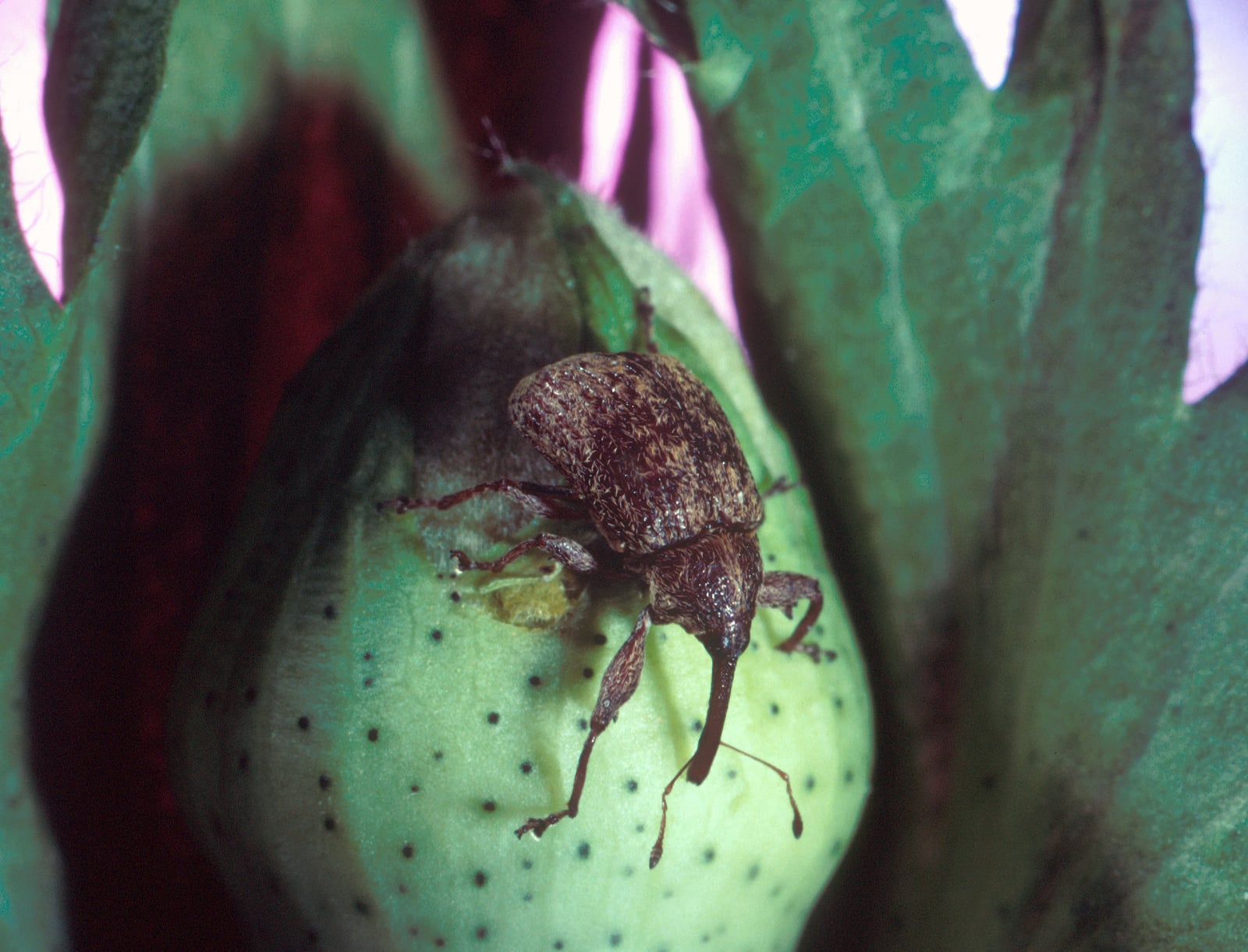
The boll weevil did not arrive with fanfare. A small gray-brown insect — five to seven millimeters, a curved snout, unremarkable in every physical way — it entered the United States from Mexico through south Texas around 1892 and spent the next two decades working its way north and east across the cotton South. It reached Montague County around 1910. By 1921, roughly 34% of the cotton crop was being destroyed annually. By the 1930s, the cotton economy that had driven MoCo’s population from 890 to more than 25,000 was in collapse.
The Weevil Arrives
Anthonomus grandis — the boll weevil — is a cotton specialist. Its life cycle aligns precisely with the cotton plant:
- Adults feed on cotton squares (the developing flower buds that will become bolls)
- Females lay eggs inside developing bolls, sheltered from hand-picking and early pesticides
- Larvae develop inside the boll, feeding on the cotton fibers before they mature
- Multiple generations per growing season amplify the damage
- Adults overwinter in nearby vegetation, surviving to infest the next year’s crop
The weevil’s reproductive rate, combined with its ability to destroy bolls before the cotton fiber develops, made it devastating in a way that most agricultural pests are not. Yield reductions of thirty to eighty percent in unmanaged infestations were documented across the cotton South. By the time farmers understood what they were dealing with, the pest was already established across the field.
The regional spread was inexorable: entering at Brownsville in the 1890s, moving northeast across the cotton zones at roughly fifty to one hundred fifty miles per year, reaching the Red River country of north Texas by around 1910. MoCo’s position — at the northern fringe of the Texas cotton belt — put it on the later end of the arrival timeline, roughly twenty years after the first Texas infestation. That delay did not make the impact lighter; it simply meant the county’s farmers had two decades of expansion and peak production before the reckoning arrived.
Crop Losses
The 1914 peak — 43,595 bales harvested — was achieved despite weevil presence. High wartime cotton prices and maximum planted acreage temporarily masked the damage. Farmers planted more to compensate for weevil losses. That strategy had a ceiling.
After 1914, no year in MoCo’s history matched the peak production. The post-1920s trajectory was clear and largely irreversible:
- Post-1930s typical production: under 9,000 bales — roughly 20% of 1914 peak
- Acreage in cotton contracted from approximately 78,000 acres at peak toward a fraction of that by mid-century
- Per-acre yields fluctuated with weather and pest pressure but never recovered to pre-weevil levels without chemical control that was expensive relative to the crop’s declining profitability
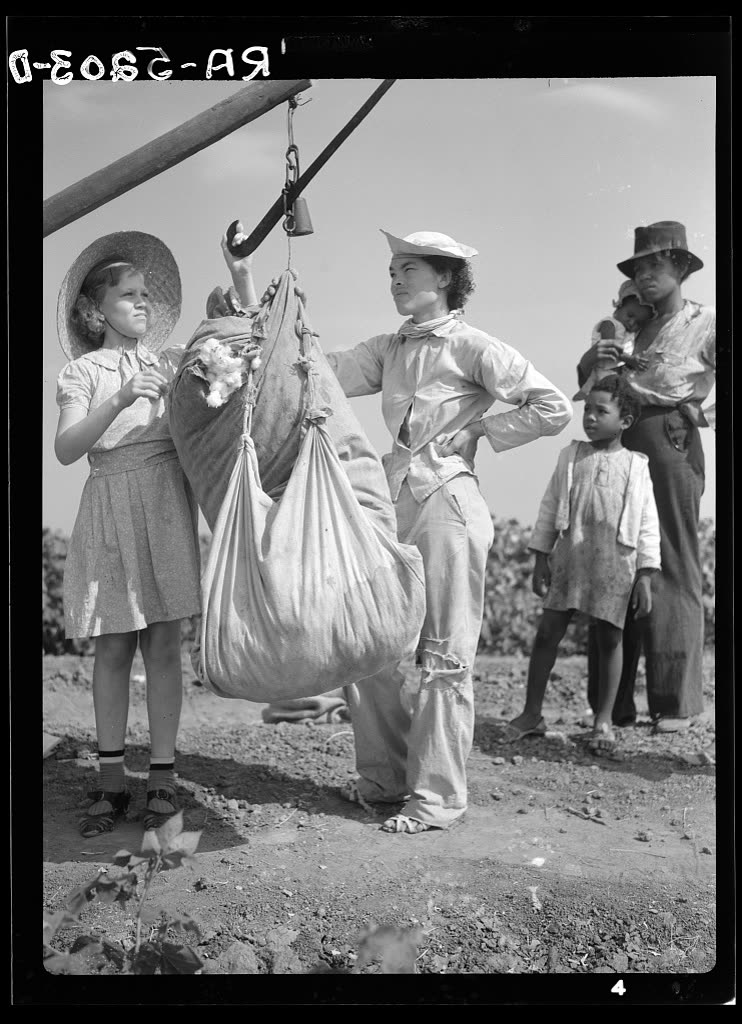
The mathematics of the collapse are in the bale counts. What the numbers do not capture is what the collapse meant at the farm level: for tenant families whose entire economic standing rested on a crop that was now producing at 20% of expected yield while their debt to the country merchant was fixed, the arithmetic ended in foreclosure, abandonment, or departure.
Farm Abandonment
The first to leave were the farmers with the least margin: tenant families and sharecroppers who held no land equity. When the crop failed to settle the merchant’s advance, there was nothing left to stay for. The pattern across the cotton South was consistent: tenants moved to the nearest town, or to Wichita Falls, Fort Worth, and Dallas, or out of state.
Small landowners held on longer — there was land equity to protect — but the combination of weevil damage, post-WWI cotton price crash (prices fell from roughly 16 cents per pound in 1919 to 5 cents in 1932), and then Depression-era banking failures overwhelmed many of them by the early 1930s. Banks failed across Texas — more than 200 failures in the 1920s and 1930s combined — taking with them the crop credit that had financed spring planting.
Farm consolidation was the structural outcome: foreclosures and departures concentrated land in fewer hands, usually those with enough capital to survive multiple bad years. The tenant farming landscape of the cotton peak gave way to larger, less densely populated ranch and farm operations. The Saturday trade day culture of MoCo towns — crowded with farm families who came in weekly from the densely populated cotton countryside — thinned out as the farming population shrank.
Agricultural Transition
The counties that survived the boll weevil crisis best were those that found replacement crops and land uses. Montague County’s transition, while difficult, ultimately succeeded in producing a more diverse agricultural economy than the cotton monoculture it replaced.
Cattle returned to dominance. Cow-calf operations expanded as cotton acreage was retired to pasture. The Cross Timbers soils that had been marginal cotton ground proved entirely adequate for native and improved grasses.
Fruit orchards emerged as a specialty. The sandy loam uplands that had carried mediocre cotton yields proved well-suited to apples and peaches. By 1980, the county led Texas in apple production and ranked sixth in peach production — a remarkable outcome from the collapse of a different crop. See Apple and Peach Orchards in Montague County.
Watermelons found their niche in the southeastern county around Forestburg, where soil conditions suited vining crops. The Forestburg Watermelon Festival has run for more than 45 years and outlasted the economic conditions that originally produced it. See Watermelons.
Oil added a new economic stream. The KMA Oilfield deep discovery in March 1931 — timed almost exactly to the Depression’s worst year for cotton farmers — provided royalty income, employment, and county tax revenue that partially offset the cotton collapse. See The KMA Oilfield.
Control Efforts
Early response to the boll weevil was largely ineffective. Hand-picking of weevils was labor-intensive and unscalable across thousands of acres. Cultural practices — early planting dates to mature cotton before peak weevil populations, fall stalk destruction to reduce overwintering habitat — provided partial benefit.
Calcium arsenate dusting, adopted in the 1920s, was the first chemical control with meaningful effectiveness. Applied by bag dusters and later mechanical equipment, it knocked down weevil populations enough to support continued cotton production but at substantial cost in labor, money, and toxicity.
Subsequent chemical generations — including DDT post-WWII and later synthetic insecticides — provided better control. The eventual solution was an eradication program: the Texas Boll Weevil Eradication Foundation, operating from the 1990s onward as a state-managed coordinated effort, used intensive pheromone trapping and targeted insecticide applications to eliminate the weevil from most of Texas by the 2010s. By the time eradication succeeded, cotton had already largely left Montague County. The fields where 40 gins processed 43,000 bales were producing hay and cattle.
The Cultural Memory
The cotton collapse in MoCo is remembered through family stories, photographs, and the physical remnants scattered across the former cotton country:
Abandoned tenant houses — small wood-frame structures, most decayed beyond salvage — mark the locations of farm families that the boll weevil and Depression displaced. Drive the rural roads of MoCo’s eastern and central sectors and the house outlines are still visible at intervals.
Demolished gins — the 40 cotton gins of 1914 have almost entirely disappeared. Concrete pads, the occasional brick remnant, the “old gin road” on county maps. A few were adapted as warehouses or grain storage; most were torn down for the lumber.
Family stories of the era carry the weight that statistics cannot. Older MoCo residents whose parents or grandparents farmed through the weevil years recall the specific texture of that period: what the crop looked like when the squares dropped, what a 34% loss meant for a family on a crop lien, who left and who stayed and why.
The mythology of the cotton era sometimes romanticizes the peak years. The actual experience for most tenant and sharecropper families — before and during the boll weevil crisis — was poverty, hard labor, and economic insecurity that the weevil made catastrophic rather than merely chronic.
Related pages: The Cotton Era in Montague County · The Dust Bowl and Great Depression · WPA and CCC in Montague County · Cattle-Cotton-Oil Era Index
Sources: TSHA Handbook of Texas (Boll Weevil entry, Montague County entry); U.S. Census Bureau population data (1910–1940). Specific MoCo boll weevil arrival date (circa 1910) and damage percentages (1910: ~6%; 1921: ~34%) are from regional themes documentation; exact figures require USDA county-level agricultural records for primary-source confirmation.