In the spring and summer of 1937, WPA workers — local men paid from federal funds — built an elementary school in Forestburg, Texas, with a facade modeled after the Alamo. Stone construction. Mission-revival lines. The iconic parapet silhouette of the most recognizable building in Texas history, reproduced in a small Cross Timbers community of a few hundred residents as a public school in the depths of the Great Depression.
The Forestburg WPA school is Montague County’s most architecturally distinctive New Deal project and its most documented one. It is not the only federal program legacy in the county — the Works Progress Administration and Civilian Conservation Corps together put money, labor, and infrastructure into north Texas communities across a decade of federal intervention — but it is the one that left a building you can still visit. (The original burned in 1995; it was rebuilt the following year in similar style and remains in use as Forestburg ISD, enrollment approximately 190 students.)
What Was the CCC?
The Civilian Conservation Corps was established by the Emergency Conservation Work Act on March 31, 1933 — one of Franklin Roosevelt’s First Hundred Days New Deal programs. It operated until 1942 and enrolled young men aged 17–28 in supervised work camps, paying $30 per month, of which enrollees sent $25 home to their families and kept $5.
The CCC’s mission was conservation work on public lands: national forests, state parks, grasslands. Texas CCC enrollees built or developed Caddo Lake State Park in East Texas, contributed to early Big Bend infrastructure, worked Possum Kingdom in Palo Pinto County, and developed dozens of other state park sites across Texas. An estimated 40,000 Texas men served in the CCC across the program’s life.
For Montague County, the CCC picture is indirect. MoCo did not have major federal park or forest land that would justify a dedicated camp. What is probable — though not confirmed in available sources — is that MoCo young men enrolled in the CCC and served at camps in nearby counties, returning home after their service with wages saved and skills acquired. Soil conservation work adjacent to MoCo may also have involved CCC labor. A complete inventory of MoCo CCC connections requires Texas CCC alumni records and county history archives.
What Was the WPA?
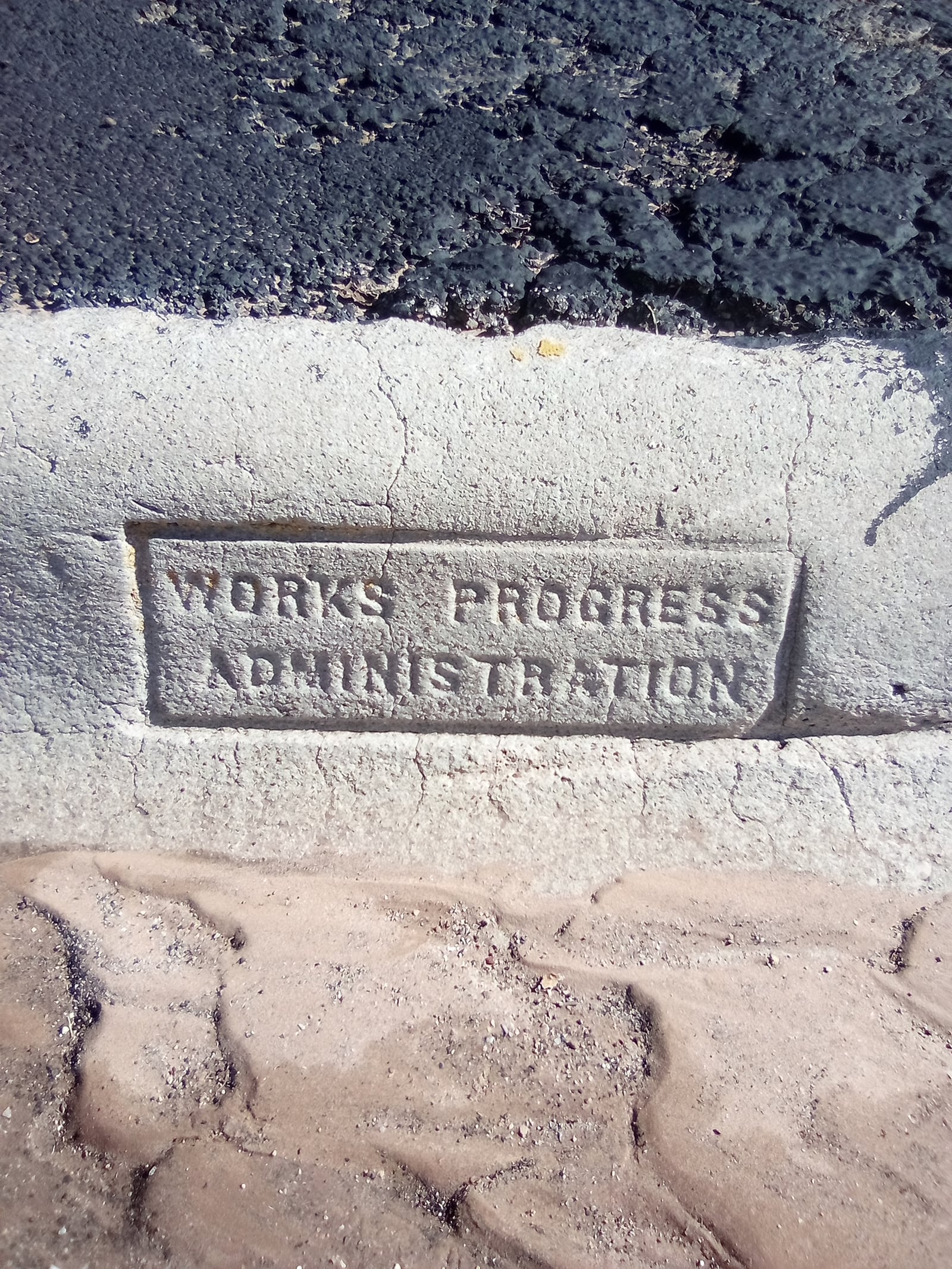
The Works Progress Administration — renamed Work Projects Administration in 1939 — was established in April 1935 under the Emergency Relief Appropriation Act and operated until 1943. Where the CCC employed young men on conservation work, the WPA employed unemployed adults of all kinds on a broader spectrum of public works:
- Schools, courthouses, libraries (construction and renovation)
- Roads, bridges, drainage
- Parks and recreational facilities
- Utilities — water systems, sewer
- Arts — Federal Theatre Project, Federal Writers’ Project, Federal Art Project
- Education — literacy programs, school enrichment
- Historic American Buildings Survey (HABS)
- Texas Slave Narratives — oral history interviews with formerly enslaved people
The WPA’s reach across Texas was massive. Dozens of school buildings, courthouses, and post offices carry WPA construction dates. Approximately 600,000 Texans were employed at peak program operation. The WPA’s distinctive architectural aesthetic — rough-hewn limestone, cedar timber, art-deco and mission-revival influences — is visible across the state in buildings that are now themselves historic.
Why Did Forestburg Build an Alamo Replica?
The choice of the Alamo’s silhouette for a Depression-era elementary school facade is unusual enough to notice. Stone construction was the practical WPA aesthetic: local stone required less expensive transportation than manufactured materials, local stoneworkers could be employed from the area’s unemployed population, and the result was durable. The mission-revival line was both culturally legible — Texas identity, the founding story, the Alamo as the most charged symbol in Texas public culture — and architecturally achievable in rough stone by a skilled masonry crew.
What the Alamo-replica facade communicated in 1937 was civic commitment: this community, in the worst economic moment of living memory, was building something permanent and distinctive for its children. The WPA’s program design required that projects be locally meaningful; the Forestburg school, with its explicit reference to the Texas founding, was locally meaningful in the most direct way.
The school served the Forestburg community across generations. When it burned on 1995, the community rebuilt it — in 1996, in similar style. The rebuilt school is the current Forestburg ISD building.
What Other WPA Work Reached Montague County?
The Forestburg school is the documented flagship, but it was almost certainly not the only WPA work in MoCo. A full inventory requires research in the Texas State Library and Archives Commission (WPA records) and the Library of Congress (WPA online resources), which hold project-by-project documentation.
Probable MoCo WPA work includes:
Road and bridge construction. WPA built rural roads and bridges across Texas in enormous volume. MoCo, as a county with significant road infrastructure needs and an unemployed rural labor force, almost certainly received road work funding. Some surviving MoCo road or bridge infrastructure may date to WPA construction without being labeled as such.
Post offices. WPA constructed or renovated post offices across small Texas towns. Bowie, as the county seat, is a candidate; smaller MoCo post offices may also have received WPA attention.
County courthouse work. The Montague County Courthouse was built in 1913, predating the WPA, but may have received WPA repair or renovation work.
School buildings. Beyond Forestburg, other MoCo school districts may have received WPA construction funding. The Forestburg school’s documentation is the clearest because its design was distinctive; other WPA school buildings might not be as immediately identifiable without records research.
What Did the Soil Conservation Service Do in MoCo?
The Soil Conservation Service (now USDA NRCS), established in 1935 in direct response to the Dust Bowl, brought technical assistance and federal cost-sharing to erosion-damaged farmland across north Texas. In MoCo, the Soil Conservation Service’s Depression-era work likely included:
- Terracing of cotton and grain cropland to slow runoff
- Strip cropping demonstration plots
- Grass-strip waterways to channel runoff without erosion
- Cover crop practice promotion
- Pond construction for water retention and erosion control
- Soil surveys documenting county soils for management purposes
Surviving MoCo terraces and grass waterways on older properties may trace to this era’s Soil Conservation Service work. The technical vocabulary of modern north Texas range and farm management — contour plowing, terrace systems, waterway design — entered common practice through SCS programs of the 1930s.
Who Did the Work?
The people who built the Forestburg school, graded the WPA roads, and terraced the MoCo cotton fields were local. The WPA’s program design required hiring from local unemployed rolls; this was not imported labor but MoCo residents — carpenters, masons, laborers, farm workers — given federal wages for public work during years when private-sector employment had essentially collapsed.
The workers who built the Forestburg school are not named in available sources. The WPA administrative record captured project specifications, costs, and completion dates; it did not document individual workers. The oral history of who built what in MoCo during the Depression — which families provided the labor, what the work conditions were like, what the federal wages meant to families facing foreclosure — requires oral history research to recover. Adults born 1940–1950 who grew up in families with Depression-era WPA experience are in their late seventies and eighties in 2026.
What Lasted?
The New Deal’s physical legacy in Montague County is the most durable part of its story:
- The Forestburg school (1937 original; 1996 rebuild) — in active use
- Roads and bridges — some WPA-era construction survives within later-improved road corridors
- Soil conservation terraces — visible on older agricultural properties across the county
- The infrastructure expectation — the New Deal transformed rural communities’ understanding of what federal government could provide and what it should
That last item is the least tangible and the most consequential. North Texas counties that had functioned with minimal federal infrastructure investment for generations came out of the 1930s with public buildings, improved roads, and a labor force that had experience with systematic public-works organization. The WPA and CCC did not save the cotton economy — nothing was going to save the cotton economy — but they provided the bridge infrastructure that kept communities functional through the worst years and into the gradual recovery.
Related pages: Dust Bowl and Depression in Montague County · Rural Electrification in Montague County · Cattle-Cotton-Oil Era Index
Sources: National Archives and Records Administration (New Deal programs); Texas State Library and Archives Commission (WPA records); Forestburg ISD. Forestburg WPA school built 1937 (Alamo-replica design), burned 1995, rebuilt 1996, enrollment ~190: confirmed from multiple sources. CCC established March 31, 1933; WPA established April 1935: confirmed national program dates. Montague County-specific WPA project inventory remains incomplete in published sources.