The 1930s arrived in Montague County as the third act of a crisis already two decades in the making. The boll weevil had been collapsing cotton yields since around 1910. The county’s population had already declined from its 1910 peak of 25,122. The land-tenure structure of the cotton era — crop liens, tenant farming, country merchants as bankers — had been under stress through the entire 1920s. When the Great Depression hit in 1929 and the Dust Bowl drought compounded the agricultural losses through the 1930s, MoCo entered the decade already weakened and emerged from it smaller and permanently changed.
Drought Arrives
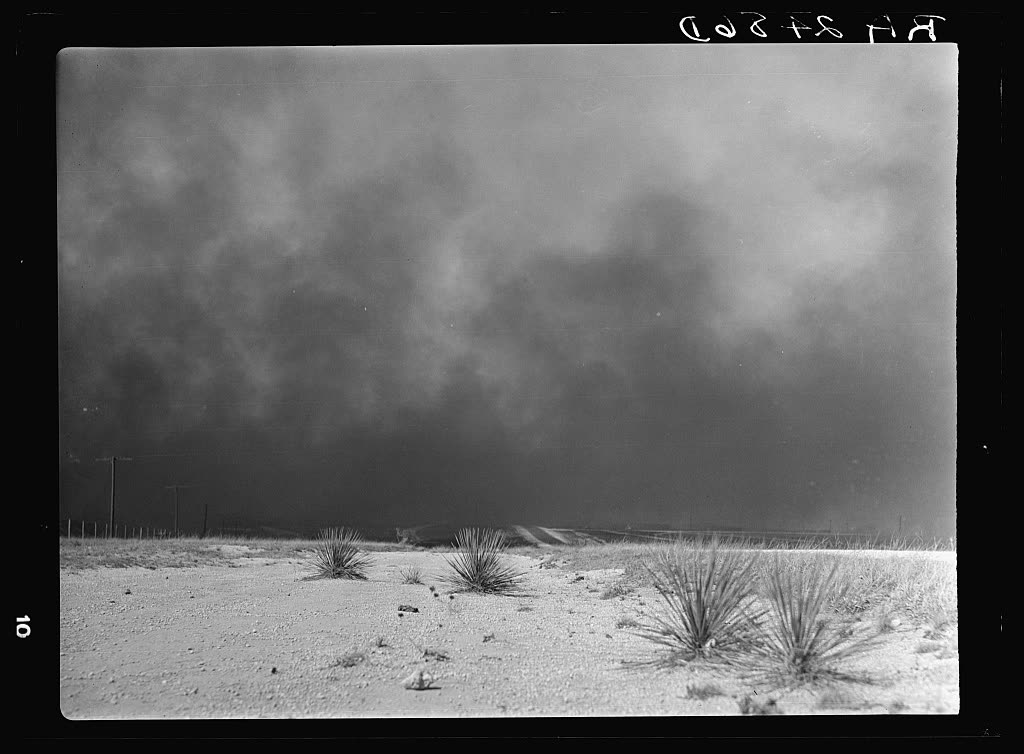
Montague County was not the Dust Bowl’s epicenter. The iconic imagery of the era — the black blizzards rolling across the Texas Panhandle and western Oklahoma, the catastrophic soil loss of “No Man’s Land” — belonged to counties two hundred miles to the west. MoCo sat at the dry eastern edge of the storm zone.
That geographic distinction is real but should not be overstated. The county experienced:
- Reduced rainfall through the early and middle 1930s, extending a dry period that had begun in the late 1920s
- Depleted soil moisture across former cotton fields whose topsoil had been loosened by decades of cultivation and was vulnerable to wind erosion
- Failed crop years that compounded the market-price collapse
- Dried wells and stock tanks creating livestock stress
- Rangeland deterioration affecting the cattle operations that were supposed to replace cotton
The drought in MoCo wasn’t the catastrophic, Biblical-scale event of the Panhandle. It was the kind of sustained, grinding moisture deficit that arrives during a year when you cannot afford any additional losses, and then stays.
Crop Failure
Cotton prices collapsed alongside the drought. The sequence was punishing:
- 1929: Cotton approximately 16 cents per pound
- 1932: Cotton approximately 5 cents per pound — a 70% drop in three years
- 1933: Federal cotton programs began paying farmers to destroy planted acreage, acknowledging that the only path to price recovery was drastic supply reduction
For MoCo farmers already dealing with boll weevil damage reducing yields to roughly 20% of the 1914 peak, a simultaneous 70% price collapse removed the economic justification for continued cotton farming entirely. Farmers who were still growing cotton on crop liens — obligated to the merchant for seed, food, and supplies advanced in spring — faced harvest proceeds that could not cover the debt. The arithmetic led to foreclosure.
The Agricultural Adjustment Act of 1933 paid MoCo farmers to reduce cotton acreage — a federal program explicitly designed to raise prices by cutting supply. That program, while providing immediate cash to participating farmers, also accelerated the structural withdrawal from cotton. Acreage that came out of production for AAA payments often did not return.
Population Collapse
The Census trajectory through the Depression decade:
- 1910: 25,122 — MoCo peak
- 1920: approximately 24,000 — slight decline
- 1930: approximately 22,000 — cotton collapse continuing
- 1940: 20,442 (U.S. Census Bureau) — the Dust Bowl and Depression decade’s net loss was approximately 1,600 residents, or roughly 7%
The 7% figure is smaller than popular memory of the era might suggest, and smaller than the declines in harder-hit Panhandle counties. Two factors moderated MoCo’s loss: the county was not a pure cotton monoculture by 1930 (cattle had been returning to dominance since the weevil crisis), and the KMA Oilfield discovery in March 1931 provided a partial counter-current of employment and royalty income during the worst Depression years.
Out-migration ran primarily to:
- Texas cities — Wichita Falls, Fort Worth, Dallas, where defense industry buildup would accelerate employment by 1940
- California — agricultural and industrial work
- Other regions as opportunities appeared
The families who left were disproportionately tenant farmers and sharecroppers — those with no land equity to defend. Small landowners held on longer. Established ranch families with diversified operations weathered the decade better than cotton-dependent families, though cattle prices also collapsed through much of the 1930s.
WPA and CCC Relief
Federal New Deal programs reached MoCo and left physical evidence still present decades later.
The Civilian Conservation Corps (CCC), established 1933, provided employment for young men in conservation and public-works projects. CCC camps in the broader region worked on soil conservation terracing, road-building, and reforestation projects. Some MoCo residents participated in regional CCC programs.
The Works Progress Administration (WPA), established 1935, built public infrastructure across rural Texas. In Montague County, the most documented WPA project is the Forestburg school — built in 1937 as an Alamo replica, a distinctive structure that served the Forestburg community until it burned in 1995 and was subsequently rebuilt. Other WPA projects in MoCo — smaller road improvements, public building renovations — require a primary-source inventory that hasn’t been assembled. See WPA and CCC in Montague County for the full treatment.
The Rural Electrification Administration (REA), established 1935, brought electricity to rural Texas through cooperative utilities. MoCo’s rural electrification followed the REA cooperative model, connecting farms and rural households that private utilities had not reached. See Rural Electrification in Montague County.
The Agricultural Adjustment Act (AAA) paid farmers to reduce acreage, providing cash during the market crisis while restructuring the cotton supply. Participation was widespread but not universal; some MoCo farmers objected on principle to government programs that paid for not farming.
The KMA Counter-Current
The KMA Oilfield deep discovery in March 1931 arrived at the precise nadir of the Great Depression and provided a meaningful, if partial, counter-current to the agricultural crisis.
The discovery of the Strawn formation zone at approximately 3,800 feet — following the earlier 1919 shallow discovery — revitalized field production during years when every other economic metric in north Texas was falling. The benefits to Montague County were real but secondary to the field’s Wichita County center:
- Royalty income for MoCo landowners in the field area
- Employment for MoCo workers in field development and service operations
- County tax revenue from production taxation
- Economic activity in north MoCo communities near the field
KMA was not enough to offset the Depression-era losses. MoCo’s population still fell through the 1930s. But the oilfield cushioned the fall. See The KMA Oilfield for the full field history.
Banking and Credit
MoCo’s cotton-era banking system — multiple banks in Bowie at peak, country merchants as informal agricultural credit providers across the county — came under severe stress through the 1929–1933 contraction.
Texas experienced more than 200 bank failures in the 1920s and 1930s combined. Specific MoCo bank failures and consolidations require primary research at county and state banking records, but the broader pattern — contraction from the multiple-bank cotton-era peak toward a smaller, more consolidated post-Depression banking sector — reflects the statewide experience.
The Federal Deposit Insurance Corporation (FDIC), created by the Banking Act of 1933, restored confidence in the banking system by insuring deposits in member banks. The Federal Land Banks and Production Credit Associations provided agricultural credit that replaced the collapsed private credit infrastructure. These federal institutions rebuilt the rural credit system that the crop-lien merchant economy had failed to sustain.
Recovery and WWII
By the late 1930s, the worst was passing. New Deal programs had provided partial stabilization. The 1936–1937 brief recession had set back recovery temporarily, but by 1938–1939 conditions were improving.
WWII accelerated the recovery in ways that Depression programs had not. Wartime demand drove agricultural and petroleum prices upward. Defense industry employment in Fort Worth and Dallas drew MoCo workers and their families — sometimes representing a permanent departure, sometimes a wartime relocation with return to follow. Returning veterans after 1945 reshaped many communities across north Texas, some coming home, some staying where wartime work had taken them.
By 1945, the Depression and Dust Bowl era was conclusively past. MoCo entered the postwar period with a smaller population than in 1910 but with an agricultural base that was diversifying beyond the cotton monoculture that had collapsed. The cattle, hay, fruit, and oil mix that defines modern MoCo agriculture began taking its current shape in the fifteen years after the Depression ended.
The Legacy
The 1930s left marks on Montague County that are visible across multiple dimensions:
Demographic: The population never recovered to 1910’s 25,122. The 2020 census shows approximately 20,000 residents — roughly the same as 1940. The people who left during the Depression established families elsewhere; their descendants’ connections to MoCo persist in some cases as cultural ties rather than residence.
Physical: WPA-era buildings, REA electric infrastructure, and soil conservation terracing remain from the era. The Forestburg school rebuild maintains the Alamo-replica design of the 1937 original.
Cultural: MoCo residents born in the 1910s and 1920s who survived the Depression carried its specific lessons through their lives: frugality, self-sufficiency, distrust of banks and single-crop dependence, and a particular relationship to land as the one asset that could survive almost anything if you held it. Those values shaped the county’s postwar culture and persist in modified form in current rural MoCo identity.
Economic: The federal institutions established during the New Deal — crop insurance, agricultural credit, rural electrification, deposit insurance — remain present in MoCo’s economic infrastructure. The county participates in USDA programs, electric cooperatives, and federal land conservation schemes that trace their lineage directly to the 1930s relief response.
Related pages: The Boll Weevil Crisis · WPA and CCC in Montague County · The Cotton Era in Montague County · Cattle-Cotton-Oil Era Index
Sources: U.S. Census Bureau population data (Montague County, 1910–1940); TSHA Handbook of Texas (Great Depression in Texas, New Deal, Montague County entries). 1940 population corrected to 20,442. Specific MoCo bank failures and family migration patterns require county clerk records and family oral history research for primary-source documentation.