National Prohibition (1920–1933) was an imposition on most of America. In Montague County, it was almost redundant — the county had already voted itself dry.
The temperance tradition in MoCo ran deep and ran early, driven by the same Methodist and Baptist church culture that shaped most of rural north Texas through the 19th and early 20th centuries. Texas enacted statewide prohibition in 1918, two years before the 18th Amendment made it federal law. By the time federal Prohibition took effect in January 1920, MoCo’s relationship with alcohol had already been shaped by decades of local-option voting, saloon regulation, and the competing moral frameworks that made Prohibition simultaneously popular and evaded.
What followed was a predictably human story: official dryness coexisting with unofficial drinking, creek-bottom stills operating in the cedar-choked draws of the Cross Timbers, and a culture of moonshining and bootlegging that persisted in family memory long after the legal status of alcohol changed several times over.
The Saloon Era and the Temperance Response
Cattle-Trail Drinking Culture
Before the temperance movement reshaped MoCo, the county had towns that served the thirsty. Saint Jo in the 1870s and 1880s was a cattle-trail stopping point, and stopping points had saloons. The Stonewall Saloon, built from native stone in 1873, was the most prominent — a structure that survives today as a museum, its stone walls outlasting every argument about what it should have sold.
The drovers, cowboys, and traders who moved through the Red River corridor were not temperance advocates. Alcohol-related violence in cattle-trail towns was real and documented. The saloon was the social institution of the trail economy, and MoCo’s towns participated fully in that economy.
The Temperance Movement Takes Hold
The push against that culture came from the churches — Methodist and Baptist congregations that formed the social backbone of rural north Texas communities — and from organized political action through the Women’s Christian Temperance Union (WCTU) and the Anti-Saloon League. Texas law allowed local-option voting at the county or precinct level, meaning communities could vote themselves dry without waiting for state or federal action.
Saint Jo’s very name carries a temperance marker of a peculiar kind. One of the town’s namesake figures, Joe Howell, was a temperance advocate whose position was apparently referenced sardonically when the town was renamed in 1872 — the renaming acknowledged, with some community irony, the temperance politics that were already part of the town’s identity.
MoCo voted dry at some point in the pre-Prohibition era; the specific date requires verification against Texas Secretary of State precinct records. What is clear is that by the time national Prohibition arrived, MoCo was already operating in a legally dry environment.
National Prohibition (1920–1933)
The Framework
The 18th Amendment was ratified in January 1919 and took effect in January 1920, prohibiting the manufacture, sale, and transportation of intoxicating liquors nationwide (Source: TSHA Handbook of Texas). The Volstead Act (1919) provided the federal enforcement machinery. Texas had ratified its own statewide prohibition in 1918, making MoCo part of a doubly dry legal environment: local option, state law, and federal law all converging on the same prohibition.
Enforcement was multi-layered: federal Prohibition agents handled the most significant investigations; local sheriffs — elected by the community — enforced state and local laws with varying enthusiasm; and Texas Rangers occasionally intervened in larger cases.
The Red River Corridor
The Red River formed the natural boundary between Texas and Oklahoma — and Oklahoma was also a dry state through much of the Prohibition era, eliminating the simple arbitrage of crossing a state line to purchase legal alcohol. This double-dry border region meant that bootleggers in MoCo were not simply importing from a wet neighbor; they were operating in an environment where local production was the primary supply source.
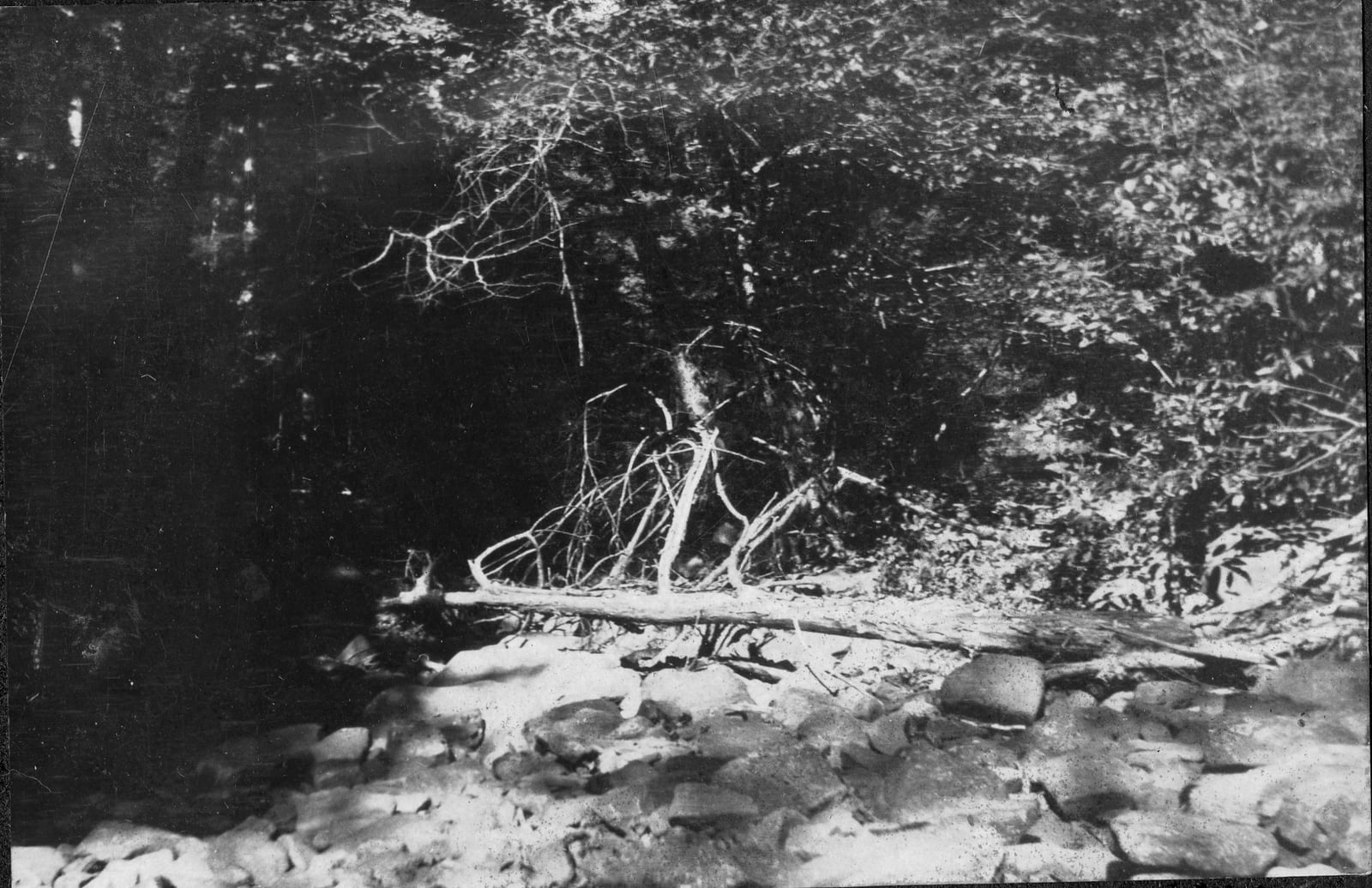
The Cross Timbers terrain of Montague County was ideally suited to concealment. Cedar-choked creek bottoms along Denton Creek, Farmers Creek, and Salt Creek provided water for distillation, firewood for heat, and dense cover from road-visible surveillance. The brushy draws of the Cross Timbers satisfied every operational requirement of a hidden still.
Moonshining in the Cross Timbers
The Still and Its Products
Illicit distillation — making corn whiskey, “white lightning,” or various grain spirits outside the federal excise tax and licensing system — was the primary response to Prohibition in rural Texas. The process: corn mash fermented over several days, then heated in a copper still to separate the alcohol vapors, which were condensed through a coil and collected in a mason jar or jug. The quality varied enormously. A skilled operator produced drinkable whiskey. An inexperienced or careless one produced a product contaminated with methanol or fusel oils that could blind or kill its consumers.
In Montague County, oral tradition insists that stills operated throughout the Prohibition era and for decades beyond. The creek bottoms were the universal location in older residents’ accounts — the logic of water, concealment, and firewood making the choice obvious. Some accounts specify particular draws along Denton Creek below Forestburg or heavily timbered sections along Farmers Creek west of Bowie; these locations are unverified oral tradition and have not been confirmed against county records or contemporary news accounts.
The area around Illinois Bend — the dramatic Red River oxbow in northeastern MoCo — appears in at least one regional account as a moonshining location, its geographic isolation and natural lookout position making approach visible from a distance. This claim is unverified oral tradition and awaits field and archival confirmation.
The Bootlegger in Folk Memory
No specifically named MoCo moonshiner has been documented in available primary sources at this research date. The history of specific operators requires newspaper archive research (Bowie News and Nocona News microfilm, accessible via the UNT Portal to Texas History), county court records, and family oral history work.
What has been documented in community memory is a recognizable character type: the independent-minded farmer — usually older, usually operating a modest still on his own land — who ran his operation by tacit neighborhood agreement. By oral tradition, he wasn’t bothering anybody; he was providing something people wanted; and the law was an outside imposition onto community arrangements that had their own moral logic.
This framing coexists, in the same county and sometimes in the same family, with genuine religious temperance conviction. MoCo was simultaneously a community with deep Baptist and Methodist anti-alcohol commitment and a community where a significant portion of the population drank regardless of the legal status of alcohol. The contradiction was lived, not resolved.
Enforcement and Its Limits
Prohibition-era law enforcement in MoCo generated its own body of folk narrative, centered on the locally elected sheriff or constable who knew exactly where the stills were but found reasons to look elsewhere: political calculation, personal sympathy, or a quiet understanding with community members who voted for him. This oral tradition is not a documented claim about any specific named MoCo sheriff — the folk narrative of the selective enforcer is a regional type documented broadly in rural Texas Prohibition history (TSHA Handbook, “Prohibition”), not a MoCo-specific allegation.
What is structurally real is the bind a locally elected sheriff faced: he served a community divided between genuine temperance advocates and genuine drinkers, and his re-election depended on navigating both. Some degree of selective enforcement — raiding the most visible or most unpopular operations while leaving others alone — would have been both politically rational and practically inevitable.
Federal agents were the more feared enforcement presence. Oral tradition describes a pattern in which federal agents were the primary enforcement threat and local law enforcement sometimes served as a buffer, occasionally warning operators before a federal raid. This characterization of federal-versus-local tension is consistent with documented Texas patterns (TSHA, “Prohibition”) and is plausible in MoCo, but specific MoCo instances remain unverified.
After Repeal: Why the Stills Kept Running
The 21st Amendment (1933)
The 21st Amendment, ratified December 5, 1933, repealed national Prohibition and returned alcohol regulation to the states (Source: TSHA Handbook of Texas). For most of the country, this ended the Prohibition experiment.
For Montague County, it was not that simple. Texas remained largely dry even after federal repeal, through the continued operation of local-option voting. Counties and precincts could maintain their dry status through local elections, and many did. The state’s mixed-beverage law — allowing on-premises liquor service — did not pass until 1971, meaning that even after national repeal, MoCo’s legal relationship with alcohol remained complicated and community-by-community variable.
The Economics of Moonshine
The federal excise tax on legal distilled spirits created a persistent economic rationale for illicit production even after Prohibition ended. Legal whiskey was taxed; moonshine wasn’t. In a county where much of the population was effectively dry by legal status anyway, a still operator could find customers even in the post-Prohibition era.
Tradition in some MoCo communities suggests still operations continued into the 1950s and possibly 1960s — not as large-scale economic enterprises but as cottage operations for personal use and trusted-neighbor sales. The BATF (now ATF) conducted periodic rural Texas still raids through this era; specific documented MoCo cases remain an outstanding archival research question.
Some hunters and rural property owners report occasionally finding old copper pipe, broken crockery, and stone-ringed fire circles in remote creek-bottom draws — artifacts they interpret as remnants of old still operations. These finds circulate as informal discovery stories rather than documented archaeological events.
The mason jar survives in family memory as the signature container, appearing in stories that don’t always distinguish between canned tomatoes and illicit whiskey — which may itself be a kind of inherited folk discretion, the ambiguity of the mason jar story persisting as a cultural artifact of the era’s necessary subterfuge.
The Dry-County Legacy
Today’s Wet/Dry Pattern
Montague County’s modern alcohol geography reflects its layered history. Some precincts are wet, others dry. Beer and wine sales are available in some areas; liquor stores operate in others; mixed-beverage permits apply to some establishments. The specific current status varies by precinct and changes through local elections — a pattern of community-by-community choice that has persisted since the local-option era of the 1880s.
The religious tradition that drove the original temperance movement continues to shape community attitudes. Methodist and Baptist congregations remain significant social institutions in MoCo towns, and the cultural weight of abstinence in those communities is real even where the legal status of alcohol has shifted.
Memory and Legacy
What persists most durably from the Prohibition era in MoCo is not a historical narrative so much as a family story layer — accounts of grandparents or great-grandparents who kept a mason jar in the root cellar, who knew a man with a still in the creek bottom, who understood that the sheriff knew but didn’t look. These stories don’t always distinguish the documented from the legendary, but they are consistent enough across MoCo family memory to reflect something real: a community that navigated the official prohibition and the unofficial practice of drinking with the particular ingenuity of people who had to live with the contradiction every day.
Related pages: Bank Robberies and Outlaws · Stonewall Saloon Museum · Modern Era Index
Sources: TSHA Handbook of Texas, “Prohibition” and “Moonshining” (tshaonline.org); prohibition-and-moonshine.md; folklore/prohibition-moonshine-lore.md (oral-tradition layer; named-still and named-moonshiner claims are unverified oral tradition, noted throughout). MoCo-specific bootlegger arrests, wet/dry election history by precinct, and family oral histories remain outstanding research questions.