World War I came to Montague County through a draft notice and a Liberty Bond drive — the same machinery that reached into every American county in the spring and summer of 1917. The war was being fought on the other side of an ocean, but its demands were immediate and local: young men registered, trained, and shipped out, while their families back in the Cross Timbers mobilized crops, cash, and volunteer labor in support of a conflict that reshaped the county’s economy as thoroughly as it reshaped its households.
The war found MoCo in transition. The boll weevil had been dismantling the cotton economy since around 1910, and the county’s farmers were already adjusting toward cattle, diversified crops, and whatever the oil fields north of town might yield. The high commodity prices of the war years — cotton at 26 cents a pound in 1917, rising toward 35 cents by 1919 — provided a brief surge before the post-war price collapse erased much of the gain. The war, in economic terms, was a false bottom under a decline that resumed once the fighting stopped.
What the war left permanently was something harder to measure: the names on cemetery stones, the American Legion posts organized within a year of the Armistice, and the civic identity of a generation of men who came back from France — or didn’t — and spent the next four decades shaping county life.
Texas and the Great War: The Scale of Commitment
The United States entered World War I on April 6, 1917, following Germany’s resumption of unrestricted submarine warfare and the revelation of the Zimmermann Telegram. Congress passed the Selective Service Act on May 18, 1917, establishing the draft machinery that would reach into every Texas county within weeks.
Approximately 200,000 Texans entered military service across the conflict’s nineteen months of US involvement, from April 1917 through the November 11, 1918 Armistice. Texas deaths in the war are estimated at approximately 5,000 — a figure derived from Texas Adjutant General records and cited by the TSHA Handbook of Texas.
The draft operated through three main registration days. June 5, 1917 registered men ages 21–30. June 5, 1918 registered men who had turned 21 since the first registration. And September 12, 1918 — sometimes called the “Great Registration” — extended the brackets to ages 18–45, reaching nearly the entire male working-age population. Each registration day generated draft cards filed at the local board level; many survive today in digitized form through FamilySearch.org (free access) and Ancestry.com.
Specific Montague County draft registration totals — the count of men registered on each date — await primary-source research at the county clerk’s office or the Texas State Library and Archives Commission (catalog.tsl.texas.gov). [TIER-1 ESCALATION NEEDED]
The Training Question: Camp Bowie Was Not in Bowie
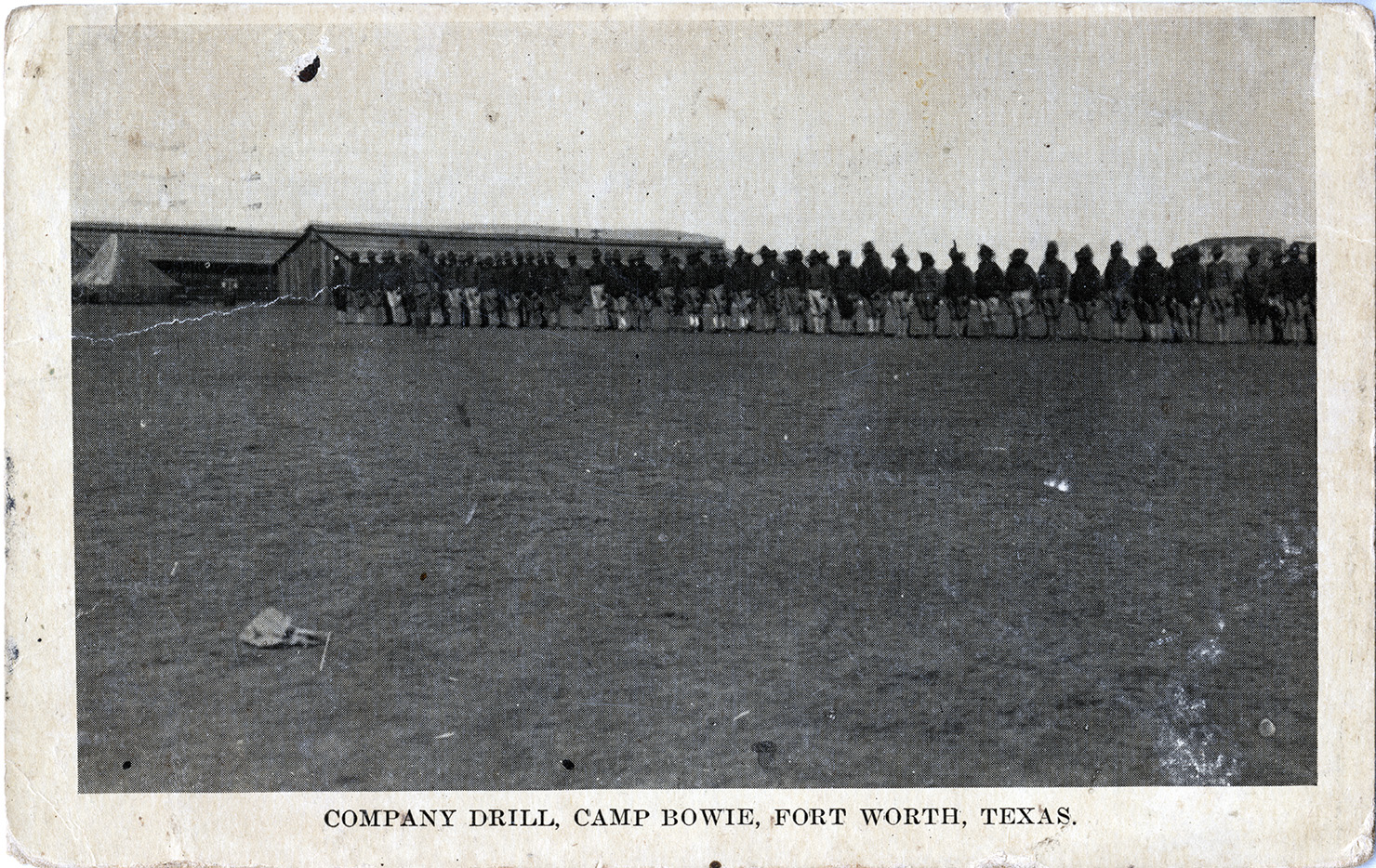
A persistent naming confusion deserves explicit correction. Camp Bowie — the World War I military training installation — was located in Fort Worth, Tarrant County, approximately 90 miles southeast of the city of Bowie, Montague County. The two places share only the name, both honoring Jim Bowie of Alamo fame.
Camp Bowie (Fort Worth) opened in August 1917 as a mobilization and training camp for the 36th Infantry Division — the “Texas Division” or “Panther Division” — a composite of Texas and Oklahoma National Guard units supplemented by draftees. The division trained at Fort Worth and shipped to France in 1918, seeing significant combat in the Meuse-Argonne and Aisne-Marne offensives during the final Allied push of the war. MoCo men assigned to Texas National Guard units or Texas-heavy draftee formations were most likely funneled through Camp Bowie (Fort Worth) before deployment.
The 90th Infantry Division (“Tough ‘Ombres”) was a second Texas/Oklahoma division that saw action at the St. Mihiel Salient and in the Meuse-Argonne. Some MoCo draftees served in 90th Division regiments.
Other north Texas training installations included Camp Logan (Houston), Camp MacArthur (Waco), and Camp Travis (San Antonio), but Camp Bowie in Fort Worth was geographically the most proximate mobilization point for Montague County draftees.
A Named MoCo WWI Veteran: Governor James V. Allred
The most prominently documented Montague County native to serve in World War I is James V. Allred (1899–1959), who was born in Bowie, Montague County, and went on to become Texas Governor (1935–1939) and later a United States District Judge.
The Texas Historical Commission marker at Bowie (THC Atlas #5337002521) records explicitly that Allred “was in U.S. Navy during World War I.” He would have been approximately 18 years old when the US entered the war in April 1917, in the age bracket swept up by the September 1918 extended registration. After his service, he was admitted to the bar in 1921 and began a legal and political career that would make him one of the most consequential figures in Depression-era Texas public life.
Allred served as District Attorney of the 30th District (1923), Texas Attorney General (1931–1935), and Governor (1935–1939). The THC marker notes that during his governorship he named Sarah T. Hughes of Dallas — later famous for administering the presidential oath to Lyndon B. Johnson aboard Air Force One in 1963 — as the first woman on the Texas judiciary. As governor, Allred also gave early encouragement to the then-aspiring LBJ, a connection that placed a Bowie, Texas, native at the intersection of some of the most consequential events in mid-20th-century American politics.
The Allred example illustrates the broader pattern: WWI veterans became the civic leaders of the inter-war and mid-century periods. The men who served in 1917–1918, and came back, filled the county’s American Legion posts, courthouse offices, school boards, and business leadership through the 1930s, 1940s, and 1950s.
Additional named MoCo WWI veterans require the TSLAC WWI Veterans Service Records (catalog.tsl.texas.gov, filterable by county) and the American Battle Monuments Commission (abmc.gov, filterable for Montague County overseas casualties). [TIER-1 ESCALATION NEEDED]
WWI Veterans in MoCo Cemeteries
Two Montague County cemeteries have been confirmed by Texas Historical Commission marker inscriptions as containing World War I veteran burials:
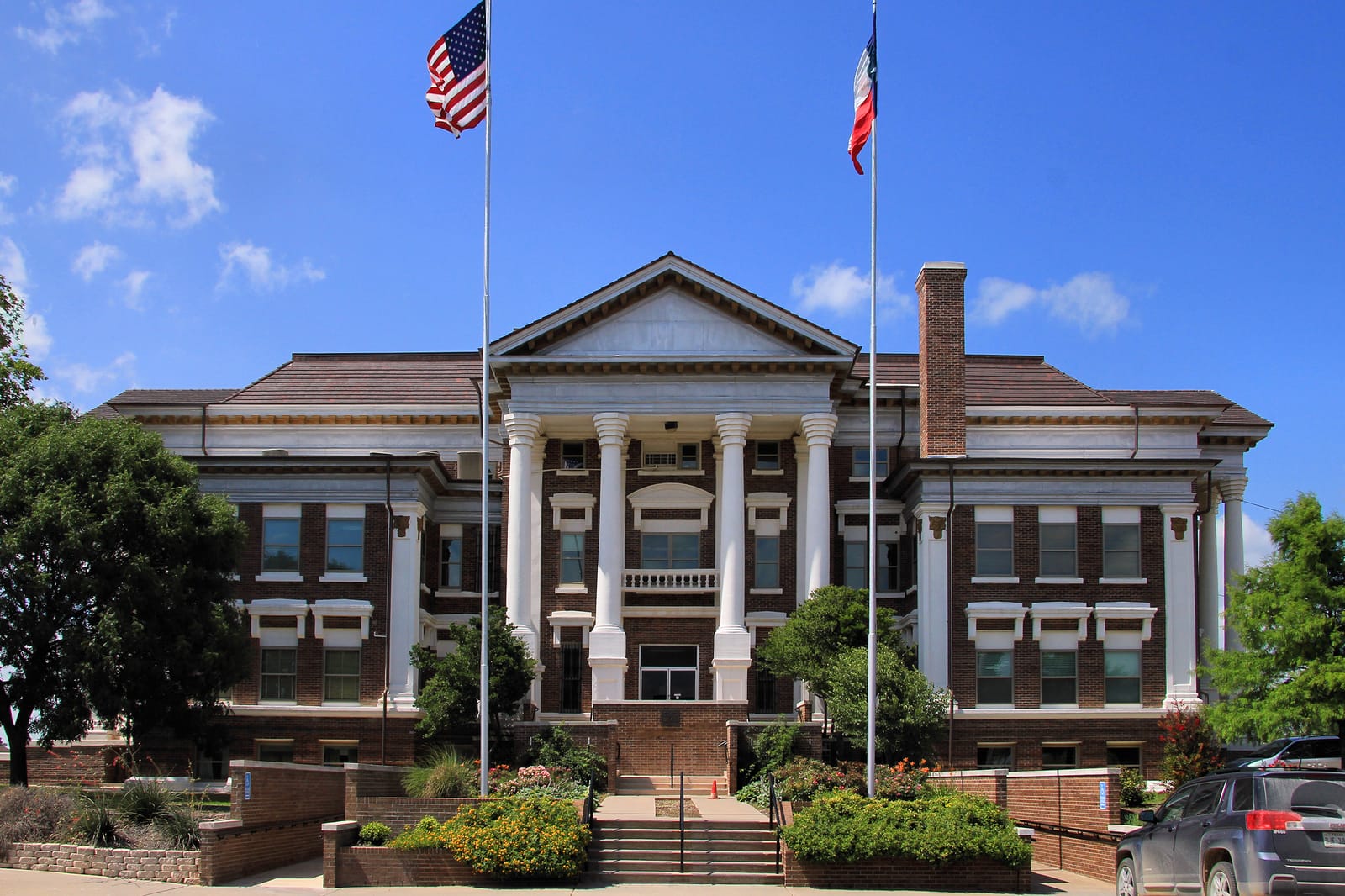
Elmwood Cemetery, Bowie (THC Atlas #5507016324): The THC inscription states explicitly that “the cemetery contains burials of veterans from the Civil War, Spanish-American War, World War I, World War II, Korea and Vietnam.” Elmwood was established in 1880 on land donated by early settler James W. Stallings, becoming Bowie’s principal civic cemetery after the town was platted in 1882. In 1981, graves from Tarter Cemetery were relocated to Elmwood due to the expansion of Lake Amon G. Carter. The cemetery is city-administered and contains a documented WWI veteran section; individual names on stones require field inventory.
Molsbee Chapel Cemetery, Nocona area (THC Atlas #5337012232): The THC inscription records that “many veterans of the Armed Forces are interred here,” listing specifically “participants in World War I, World War II and the Vietnam conflict.” The cemetery began in 1888 as a family burial ground for the Molsbee family — Church of the Brethren congregants who arrived from Tennessee — and became a community cemetery in 1942. Its location northwest of Nocona serves the rural farm families most likely to have sent sons into WWI service from the county’s more dispersed agricultural areas.
Both cemeteries represent physical confirmation of MoCo’s WWI service record, predating any formal casualty-roster research. Full name-by-name inventory of WWI veterans in MoCo cemeteries requires field transcription work at Elmwood, Molsbee Chapel, and other county cemeteries. [TIER-1 ESCALATION NEEDED]
The Home Front: Liberty Bonds, Red Cross, and Voluntary Rationing
Liberty Bond Drives
The US Treasury Department organized four major Liberty Loan drives (April 1917, October 1917, April 1918, September 1918) and a fifth Victory Loan in April 1919. Each drive was administered through county organizations, with subscription quotas set by assessed population and wealth.
In MoCo, the drives were organized through local business and civic networks — schools, churches, businesses, and the county’s newspapers all served as sales channels. The Bowie News and Nocona News of the period covered Liberty Bond drive results as a form of local patriotic competition: which neighborhood had met its quota, which businesses had subscribed, which families had purchased above their assessed share. The social pressure to subscribe was intense. Non-subscription was associated, in the wartime climate, with disloyalty.
Food Administration
The US Food Administration, headed by Herbert Hoover, promoted voluntary rationing to conserve food for Allied forces and European civilian populations. “Meatless Mondays” and “Wheatless Wednesdays” were the signature programs. In an agricultural county producing beef, wheat, and corn, the request was genuinely ironic: the farmers being asked to reduce consumption were the same people producing the commodities. Victory gardens were encouraged for home vegetable production, even in farm households that already grew food.
Farm women took on expanded food-preservation roles during the war years — canning vegetables and conserving meat at rates that went beyond normal household practice. The war expanded women’s economic roles in MoCo households, as it did across rural America.
Red Cross Chapters
The American Red Cross organized county and community chapters across Texas for bandage-rolling, surgical dressing preparation, and knitting campaigns — socks, mufflers, and wristlets for soldiers. Women’s Red Cross work was the primary home-front volunteer institution in small Texas communities. MoCo’s Red Cross chapter activities during 1917–1918 would be documented in contemporary newspaper records that have not yet been systematically searched for this project.
Anti-German Sentiment
North Texas’s German-immigrant communities were concentrated primarily in Cooke County to the east — particularly Muenster and Lindsay, communities with substantial German Catholic populations that maintained German-language church services into the early 20th century. Montague County had a considerably smaller German-born population. The general climate of wartime hostility to German culture reached the region — suspension of German-language services, public pressure on German-surnamed families — but its specific MoCo expressions are not documented in current sources.
Notably, MoCo’s Italian immigrant community — approximately fifty families of Northern Italian descent by the early 1900s, per the THC Catholic Cemetery marker — was on the Allied side of the conflict. Italy declared war on Austria-Hungary in 1915 and on Germany in 1916, meaning Montague County’s Italian residents were allied nationals, not enemy nationals.
Agricultural Economics: Boom and Collapse
The War Surge
WWI generated an export-driven commodity price surge that briefly reversed MoCo’s post-boll-weevil agricultural decline. Texas cotton traded at approximately 26 cents per pound in 1917 and 29 cents in 1918, with a peak of approximately 35 cents reached in 1919 — technically post-Armistice but driven by European reconstruction demand (Source: TSHA Handbook of Texas; Federal Reserve price data). Cattle prices rose similarly, benefiting the ranching operations that were gradually replacing cotton in MoCo’s agricultural economy. Oil and gas production in the north Texas fields increased in value as petroleum demand surged for military vehicles, ships, and aircraft.
The Post-War Collapse
The surge was brief. The agricultural recession of 1920–1921 brought sharp commodity price declines across Texas farming. Cotton prices fell precipitously from their 1919 highs; cattle prices followed. Farm debt that had accumulated during the wartime expansion — on equipment, land, and operating credit — became crushing as commodity income dropped. MoCo farm foreclosures accelerated through the early 1920s.
In north Texas, this post-war agricultural depression preceded the broader Great Depression by nearly a decade. Farms already stressed by boll weevil damage, out-migration, and debt faced the additional blow of collapsing commodity prices just as the war’s brief prosperity had created the illusion of recovery. The “Roaring Twenties” were not roaring in rural Montague County.
The American Legion and Veteran Memory
The American Legion was founded in March 1919 in Paris, France, by American officers at AEF headquarters, and incorporated by Congress in September 1919. It organized rapidly across Texas, establishing posts at the community level throughout the state.
Based on the pattern of American Legion organization in Texas, posts in Bowie, Nocona, and Saint Jo were most likely chartered between 1919 and 1922. Bowie, as the county’s largest community, probably has the best-documented post history. Specific MoCo American Legion post charter dates, post numbers, and founding membership rosters — which would document WWI veterans by name — require the Texas American Legion Department headquarters records or surviving local post archives. [TIER-1 ESCALATION NEEDED]
The Legion’s WWI veteran membership shaped Montague County civic life through the inter-war decades and the Second World War, when the same men who had served as young soldiers in France found themselves organizing support networks for their sons going to a different war.
Armistice Day — November 11 — was observed from 1919 onward as the annual day of WWI remembrance, declared a national holiday and marked with ceremonies in MoCo communities. In 1954, it was renamed Veterans Day to honor all veterans of all wars. The date has been observed in Montague County continuously ever since.
The Big Picture
World War I brought Montague County into the 20th century’s first great mobilization. The draft reached into every household and crossroads community; the home front responded with bond drives, Red Cross work, and food conservation; and the agricultural economy briefly revived before the post-war collapse resumed what the boll weevil had started.
The war’s most durably documented MoCo figure is Governor James V. Allred — a Bowie-born Navy veteran who carried his WWI service into a career that shaped Texas public life for four decades. The cemeteries at Bowie and northwest of Nocona hold the men who did not carry theirs that far.
The space between those two outcomes — the men whose service launched careers and the men whose stones stand in Elmwood Cemetery — is the human content of Montague County’s WWI experience. The records that would document it fully, name by name, are waiting in Austin and Indianapolis and in fields outside Paris that have been mowed to military-cemetery precision for over a century.
Related pages: WWII Service and Home Front · Postwar Eras: Korea and Vietnam · Modern Era Index
Sources: TSHA Handbook of Texas, “Texas in World War I,” “Camp Bowie” (tshaonline.org); Texas Historical Commission Historic Sites Atlas: Marker #5337002521 (Governor James V. Allred); Marker #5507016324 (Elmwood Cemetery, Bowie); Marker #5337012232 (Molsbee Chapel Cemetery, Nocona vicinity) — all retrieved 2026-05-11. Cotton prices: TSHA Handbook + FRED Federal Reserve price data. Specific MoCo draft registration totals, named casualty roster, and American Legion post charter records are TIER-1 ESCALATION priorities (TSLAC, ABMC, Texas American Legion Dept.).