From April through September, every fence wire in Montague County holds a scissor-tailed flycatcher. Every brushy field edge holds a painted bunting singing from a post. Every stock pond has a great blue heron standing at the margin at first light. The bird life of MoCo is not a niche interest — it is the visible surface of an ecosystem operating at full depth, and it runs from the Red River bottomlands to the open prairie corners of the western county with a species diversity that surprises people who think of north Texas as empty sky and mesquite.
Year-Round Residents
Raptors
The red-tailed hawk is the dominant year-round raptor of MoCo — visible on fence posts, utility poles, and tall trees throughout the county in every season. Its broad, rusty-red tail and high-pitched “kee-yer” scream (the hawk cry that Hollywood uses for every bird of prey) are the county’s most recognizable raptor signatures.
The great horned owl dominates the nocturnal tier. Its deep “hoo-h’HOO-hoo-hoo” call carries clearly across rural MoCo at dusk and dawn from February through summer. Barn owls work old structures and open country. Eastern screech-owls occupy woodland in both gray and red color morphs. The barred owl haunts bottomland timber with its “who cooks for you, who cooks for you-all” call.
The American kestrel — the small, colorful falcon that perches on fence wire and power lines — is present year-round, with wintering birds from the north supplementing the resident population in cooler months. The crested caracara, a South Texas species expanding its range northward, is increasingly reported in MoCo, especially in the southern county.
Songbirds and Woodland Birds
The northern cardinal is the most visible year-round songbird in any MoCo timber. The Carolina chickadee holds the eastern woodland; where the timber thins toward the west, the black-crested titmouse takes over, and intergrades between it and the tufted titmouse occur in the overlap zone — MoCo falls in the middle of that contact zone. Carolina wrens work brushy bottomlands; Bewick’s wrens favor drier upland scrub.
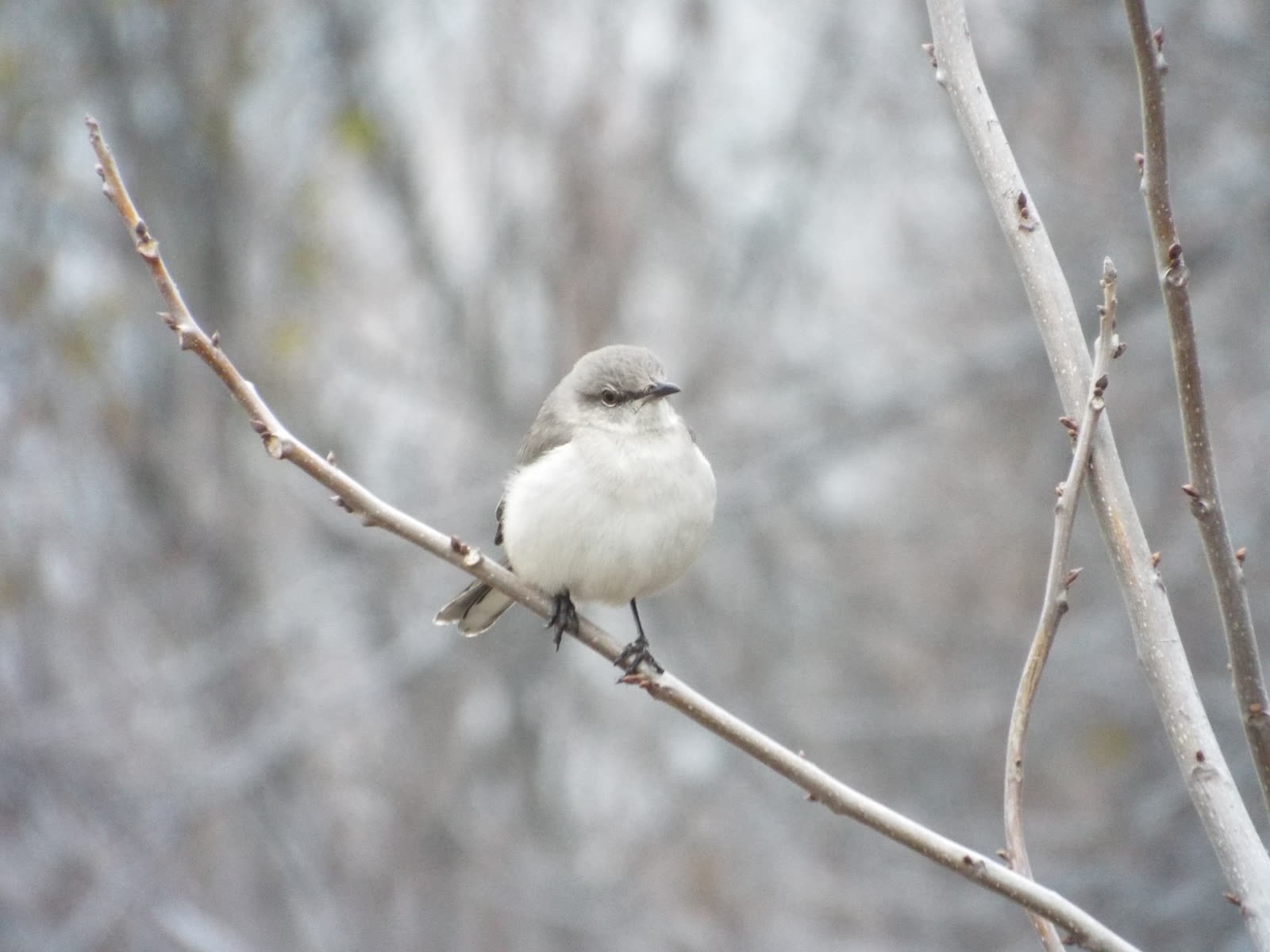
The mockingbird — Texas’s state bird — is present countywide and year-round, one of the few songbird species that sings at night. Blue jays and American crows are common in oak country. The loggerhead shrike occupies open ground with scattered perches, impaling prey on barbed wire fences in behavior that has earned it the nickname “butcher bird.”
Woodpecker diversity is good in any timber: red-bellied, downy, hairy, ladder-backed, and northern flicker all occur. The large, crow-sized pileated woodpecker is possible in heavier bottomland timber along the Red River, though uncommon.
Doves
The mourning dove is both a year-round resident and the species at the center of MoCo’s September 1 dove-hunting tradition. The white-winged dove — historically confined to south Texas — has expanded its range north dramatically over the past three decades and is now resident in MoCo towns and increasingly in rural areas. The Eurasian collared-dove, a non-native species established in North America since the 1980s, is now ubiquitous around towns and grain operations.
Spring and Summer Breeders
Scissor-tailed Flycatcher
The scissor-tailed flycatcher (Tyrannus forficatus) is MoCo’s signature bird. Arriving in late March and early April, it occupies every open perch in the county through September — fence wire, utility line, cattle pen corner post, the dead branch at the edge of a stock tank. The adult male’s tail, longer than the bird’s body, opens and closes like scissors in flight. The species’ range center is Texas and Oklahoma; MoCo is solidly in the breeding zone, and the birds are abundant enough to be genuinely unremarkable to long-term residents and genuinely astonishing to visitors from outside the region.
Painted Bunting
The painted bunting male (Passerina ciris) is the most colorful breeding bird in North America: red breast, blue head, green back. He sings from brushy second-growth edges in MoCo from April through August, and he is genuinely common in the right habitat — yet he is secretive enough that many county residents have never knowingly seen one. The Cross Timbers’ brushy uplands are painted bunting territory. If you sit at a water feature in good habitat in May, a male painted bunting may spend 20 minutes at the drip. Few encounters in Texas birding are more rewarding.
Hummingbirds
The ruby-throated hummingbird is the primary breeding hummingbird of eastern Texas, and MoCo falls in the eastern part of the range. The black-chinned hummingbird is the western counterpart; both occur in MoCo, and both can be present at the same feeder. Hummingbird migration peaks in September, when multiple species — including rufous hummingbirds moving south from western breeding grounds — move through the county simultaneously.
Other Summer Breeders
Mississippi kite — a sleek, gray aerial insectivore that catches dragonflies and large insects on the wing — is a MoCo summer breeder, often concentrated around towns where trees provide nesting structure and open sky provides hunting space. Yellow-billed cuckoos (“rain crows”) are secretive woodland breeders. Chuck-will’s-widows call from oak woodlands at dusk. Purple martins nest in colonies around farms with appropriate structures; barn swallows and cliff swallows build nests on bridge structures throughout the county.
Game Birds
Wild Turkey
The Rio Grande subspecies (Meleagris gallopavo intermedia) is MoCo’s resident wild turkey. Rio Grande turkeys favor the mosaic of brush and open ground that dominates the county — less adapted to closed forest than the eastern subspecies, more suited to the open-canopy Cross Timbers and creek-bottom corridors of north Texas. Flocks are visible year-round in the county’s ranch country.
The spring turkey season (late March through late April) draws hunters to MoCo with box calls and slate calls trying to convince a tom to commit to a decoy setup. Turkey hunting is a modest but real component of MoCo’s outdoor economy; the birds’ wariness and the calling challenge make it a skills-intensive pursuit.
Northern Bobwhite
The bobwhite quail (Colinus virginianus) was once one of the defining birds of MoCo’s agricultural landscape — an abundant ground bird whose “bob-WHITE” call was background noise in every field and brushy fence row from spring through summer. That abundance is gone. Northern bobwhite populations have declined 85 percent or more across the Southern Plains over the past 50 years, driven by the loss of old-field habitat, increased nest predation pressure, and the decline of the brushy, weedy agricultural margins that supported both food and escape cover.
Bobwhites still occur in MoCo on well-managed properties where intentional habitat work — brush management, quail-friendly field borders, predator control — maintains conditions the species needs. But the ambient population that once made bobwhites part of the county’s sonic landscape is largely gone, and recovering it is a deliberate management choice, not a default condition.
Mourning Dove
The mourning dove is the most harvested game bird in North America and the center of MoCo’s September 1 hunting tradition. The species is a year-round MoCo resident — adaptable, common in both rural and town settings, nesting multiple times per season. Its population in Texas has proven resilient to hunting pressure when habitat is maintained. The dove-hunting tradition in MoCo is cultural as much as economic: opening-weekend gatherings, family and friend groups, the marking of summer’s end.
Winter Residents
From October through March, northern-breeding birds supplement MoCo’s resident population in large numbers. Dark-eyed juncos fill brushy yards. White-crowned sparrows and white-throated sparrows occupy fence rows and field edges. Cedar waxwings descend on juniper berries and possumhaw fruit in nomadic flocks. Yellow-rumped warblers are abundant in any woodland.
Bald eagles winter on the Red River and on Lake Amon G. Carter and Lake Nocona; the species has recovered dramatically from its 20th-century low and may be establishing breeding pairs in north Texas. Golden eagles are possible in open country.
Large blackbird flocks — red-winged blackbirds, grackles, and Brewer’s blackbirds — gather in agricultural fields in the hundreds of thousands on winter afternoons, producing one of MoCo’s more spectacular (and to some landowners, problematic) winter wildlife events.
Where to Bird in Montague County
MoCo doesn’t have a designated birding hotspot of statewide reputation — no Hagerman NWR, no High Island. What it has is functional habitat distributed across the county, accessible from county roads, with the full Blackland Prairie-Cross Timbers-Red River bird community operating without management restrictions.
eBird records show consistent coverage at Lake Amon G. Carter, Lake Nocona, and Red River access points near Spanish Fort and the Belcherville bridge area. The county road system — driven slowly at dawn from late September through early November — produces fall migration tallies as good as most designated hotspots in the region. In spring, any brushy creek bottom along FM roads will hold breeding painted buntings, indigo buntings, and summer tanagers within a mile of any starting point in the county.
The county’s daily bird life — scissor-tails on every wire, mockingbirds in every front yard, cardinals in every brush pile — is ordinary to people who grew up here and quietly remarkable to anyone who arrives from a more developed landscape.
Related pages: Migratory Birds and the Central Flyway · Native Mammals of Montague County · Hunting and Fishing in Montague County
Sources: TPWD Bird Species Accounts; eBird Montague County checklist; Texas Breeding Bird Atlas (scissor-tailed flycatcher, painted bunting accounts); Lockwood and Freeman, The Texas Ornithological Society Handbook of Texas Birds (2014). General species distribution is well-documented in these sources; MoCo-specific abundance is documented but incomplete. Montague County-specific abundance data remains incomplete in published sources.