The wildflower season in Montague County runs roughly nine months — from crow poison’s tiny white stars in February to frostweed’s ice crystals on the first hard frost in November. But the heart of it is spring: the six-week window from mid-March to late April when the county’s roadsides, fence lines, and open pastures are at their most visually extravagant.
MoCo sits a few degrees north and a few hundred feet higher than the Hill Country, which means it runs about one to two weeks behind the famous Austin and Fredericksburg bloom windows. A Hill Country bluebonnet trip in mid-March often has a near-equivalent showing in Montague County by late March. The Forestburg, Saint Jo, and Sunset stretches of FM and US highways are particularly good wildflower drives.
Spring (March–May)
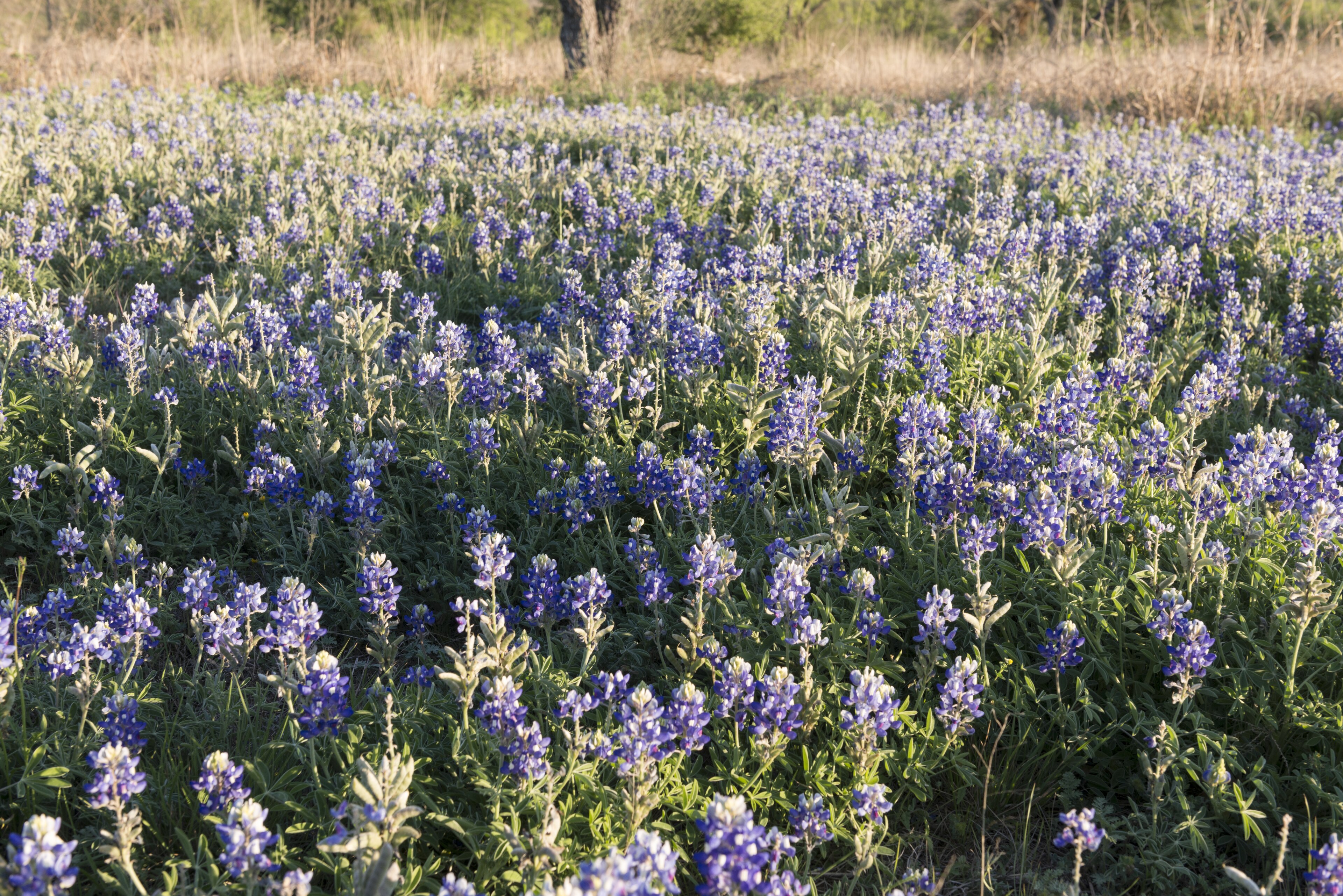
Bluebonnet (Lupinus texensis), the Texas state flower, peaks in MoCo from mid-March through mid-April. The county doesn’t produce the sheet-of-blue spectacle of the central Hill Country, but roadside colonies and disturbed prairie patches deliver reliable shows — especially when mixed with Indian paintbrush on compatible soils.
Indian paintbrush (Castilleja indivisa) is the companion species that appears almost wherever bluebonnets grow. Crimson-orange bracts on 12 to 18-inch stems. Paintbrush is technically a hemiparasite — it taps the roots of nearby grasses for water and some nutrients — which is why it grows in patches of grass rather than as scattered individuals on bare ground.
Winecup (Callirhoe involucrata) is the sprawling, deep-magenta cup-flower of Cross Timbers ground and county roadsides, blooming April through June. Its taproot was used as a starchy food by Plains peoples.
Engelmann daisy (Engelmannia peristenia) is yellow, March to June, very common on prairie remnants and overgrazed pastures — cattle leave it alone, which is why it persists while grasses get worked down.
Mexican hat (Ratibida columnifera), with its sombrero-shaped yellow-and-mahogany flowers, appears from April through October on Grand Prairie sites and roadsides. Drought-tolerant; reliable.
Prairie verbena (Glandularia bipinnatifida), spiderwort (Tradescantia spp.), blackfoot daisy (Melampodium leucanthum) on calcareous soils, and pink evening primrose (Oenothera speciosa) round out the spring prairie palette.
Antelope-horn milkweed (Asclepias asperula) flowers in April and May with greenish-white clusters. Its importance exceeds its visual subtlety: it is a critical host plant for the monarch butterfly on its spring northward migration through the Central Flyway. See the monarch butterfly file for the migration context.
Summer (June–August)
Indian blanket / firewheel (Gaillardia pulchella) is the iconic summer Texas roadside flower — red-and-yellow daisy, heat- and drought-tolerant, blooming continuously from late spring through fall. Heavy on every county road in MoCo.
Lemon mint / horsemint (Monarda citriodora) produces stacked tiers of pinkish-purple bracts from June through August, with a strong citrus-mint fragrance. Bee favorite and one of the better nectar sources for hobby beekeepers working the county’s historically documented bee-keeping tradition.
Maximilian sunflower (Helianthus maximiliani) starts blooming in late summer and peaks in September — tall stalks with multiple flower heads that line county roads and old pasture margins. It defines the look of MoCo’s roadsides in late summer the way bluebonnets define spring.
Common sunflower (Helianthus annuus), black-eyed Susan (Rudbeckia hirta), and greenthread (Thelesperma filifolium) fill the summer gaps in prairies and creek-edge disturbed ground.
Standing cypress (Ipomopsis rubra) — a spike of red tubular flowers on sandy soils in June and July — is a hummingbird magnet wherever it appears.
Fall (September–November)
Goldenrod (Solidago spp.) blooms through fall and is routinely blamed for hay fever; the actual culprit is wind-pollinated ragweed, which blooms at the same time and produces clouds of airborne pollen, while goldenrod is insect-pollinated and its pollen stays put.
Asters — heath aster (Symphyotrichum ericoides) in white sprays, aromatic aster (Symphyotrichum oblongifolium) in fragrant purple — close out the season. Gayfeather / blazing star (Liatris spp.) puts up purple spikes from August through October; where you find it in good stands, you’re on prairie that has retained some of its native composition.
Frostweed (Verbesina virginica) finishes with an unlikely spectacle: on the first hard freeze of autumn, sap inside the stem freezes and splits the bark, producing translucent ice ribbons that spiral out from the stem. The frost display lasts only until the morning sun hits it.
Habitat Variation
The Cross Timbers / Grand Prairie transition gives MoCo a wildflower diversity that neither landscape produces alone:
- Prairie remnants: Engelmann daisy, gayfeather, Maximilian sunflower, Indian blanket, antelope-horn milkweed
- Post-oak savannah openings: Paintbrush, partridge pea (Chamaecrista fasciculata), spiderwort, winecup
- Red River bottomlands and creek edges: Mistflower, swamp milkweed, frostweed, rose mallow, ironweed
- Sandy patches: Phlox, evening primrose, standing cypress
The Prairie Relict Question
Less than 1% of original tallgrass prairie remains in Texas. The best surviving prairie plant communities in many rural Texas counties are the unmowed sections of old cemeteries — ground that has never been plowed and where the full seed bank survives. Montague County’s older cemeteries almost certainly hold some of the richest native-species assemblages in the county. The connection between cemetery preservation and wildflower conservation is not coincidental: they share the same history of unbroken ground.
TxDOT’s roadside mowing coordination — timed to allow seed set for bluebonnets and other spring species before mowing begins — is standard state practice and directly benefits MoCo’s roadside wildflower shows.
See also: native trees for the woody layer, and edible and medicinal plants for the ethnobotanical context of many of these same species.