Who was Big Tree?
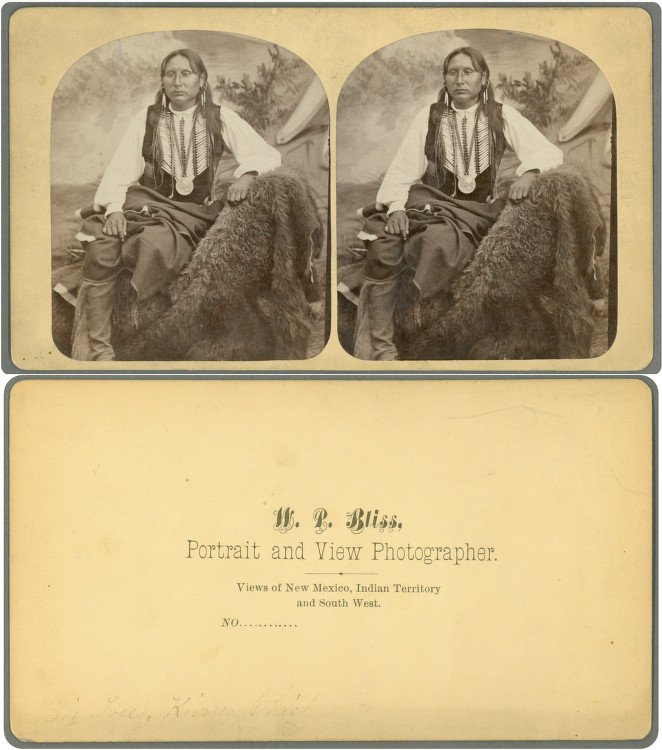
Adoeette — translated as “Big Tree” in Anglo-Texan and federal records — was a Kiowa war chief and member of the Kaitsenko, the elite warrior society of the Kiowa Nation. He was born on the Southern Plains sometime between approximately 1838 and 1850; sources disagree significantly on his birth year, and no single date can be confirmed in primary sources. The TSHA Handbook of Texas gives “ca. 1850”; earlier estimates from historian James Mooney and the Encyclopedia of Oklahoma History suggest ca. 1838–1847.
Big Tree was Kiowa, not Comanche. This distinction matters: the two nations were allied, and their warriors frequently rode together on joint operations, which led to repeated mistaken tribal attributions in 19th-century military and settler records. Any reference to a “Comanche Big Tree” in older sources reflects that confusion. The Kiowa tribal identification is confirmed by the TSHA Handbook of Texas and the Encyclopedia of Oklahoma History.
He died on November 13, 1929, at Anadarko, Oklahoma — a lifespan that covered the peak of the Kiowa raid era, the collapse of Plains resistance, reservation confinement, Oklahoma statehood, and the early automobile age. He was buried near Rainy Mountain Cemetery.
What was the Warren Wagon Train Raid?
On May 18, 1871, a combined Kiowa and Comanche war party of approximately 100 warriors attacked a government-contracted corn supply wagon train on Salt Creek Prairie in Young County, Texas — roughly 60 miles southwest of the Red River crossings in Montague County that raiders regularly used to enter Texas from Indian Territory.
Seven teamsters were killed. Five wagons were destroyed and looted. A survivor reached Fort Richardson and reported the attack. What made this raid politically decisive was timing: General William T. Sherman was at Fort Richardson when the report arrived, having passed through the Salt Creek Prairie area himself just hours before the attack. His proximity transformed the raid from a routine frontier incident into a cause for national response.
The raid’s principal leaders were:
- Satanta (White Bear) — the most senior Kiowa political figure
- Satank (Sitting Bear) — the most revered elder war leader
- Big Tree (Adoeette) — the youngest of the three named principals, regarded by contemporaries as the most formidable fighter
Sherman ordered the immediate arrest of the named leaders. Satanta, Satank, and Big Tree were seized at Fort Sill during a council meeting — at which Satanta openly acknowledged leading the raid. Satank was killed during transfer to Texas after singing his death song and attacking his guards. Satanta and Big Tree were transported to Jacksboro.
Why did the Jacksboro trial matter?
The trial at the Jacksboro courthouse in Jack County, Texas in July 1871 was the first time in American history that Native American leaders were tried in a civil court under state law for acts committed during warfare. That legal precedent — contested at the time by federal Indian rights advocates who argued it violated treaty obligations — made the case nationally reported and historically significant far beyond its Texas context.
Big Tree and Satanta were convicted of murder. Judge Charles Soward sentenced both to death. Texas Governor Edmund Davis commuted the sentences to life imprisonment — partly because the federal Indian Bureau warned that executions might trigger a general Kiowa uprising across the southern Plains. Both men were confined at Huntsville State Prison in Walker County.
In 1873, after sustained lobbying from Quaker peace advocates and federal officials, Governor Davis paroled both men over the strong objection of Texas frontier communities. Big Tree returned to the Kiowa-Comanche reservation in Indian Territory. He was, depending on which birth-year estimate is used, between 25 and 35 years old at the time of his release. For fuller coverage of the trial’s legal history, see the Jacksboro Trial spoke.
What happened to Big Tree after the parole?
The parole proved politically volatile. When Kiowa and Comanche raiding resumed during the Red River War of 1874 — the coordinated US Army campaign that ended with Colonel Mackenzie’s destruction of the Comanche horse herds at Palo Duro Canyon — Big Tree faced renewed accusations of returning to raiding. No documentary evidence conclusively establishes his participation in the 1874 raids. The Red River War ended organized Comanche-Kiowa resistance; by 1875 both nations were confined to the Fort Sill reservation. Satanta was returned to Huntsville and died there in 1878.
Big Tree was not re-imprisoned. In subsequent years, he converted to Christianity — the exact year is not recorded in accessible sources — and became affiliated with the Rainy Mountain Baptist Church near Anadarko, Oklahoma, eventually serving as a deacon. His conversion was noted at the time as symbolically significant precisely because of his documented past as one of the most aggressive Kiowa war leaders. How Big Tree himself understood the relationship between his warrior past and his Christian present is not preserved in Anglo-Texan records; that perspective belongs to the Kiowa oral tradition held by the Kiowa Tribe of Oklahoma and the Kiowa THPO.
He died November 13, 1929 — among the last surviving participants in the 1871 raid and Jacksboro trial.
What was Big Tree’s connection to Montague County?
The most direct connection is the December 1863 raid into the Illinois Bend area on the Montague-Cooke County boundary. Regional sources — including Mrs. W.R. Potter’s 1913 History of Montague County — attribute the raid to “Big Tree and other leaders,” describing approximately 250 Kiowa and Comanche warriors. That raid was the most catastrophic single Indigenous military action in Montague County’s documented history: at least twelve settlers killed, several captives taken, homesteads burned across Illinois Bend. Potter’s account names specific settler families — Wainscot, Spencer Moore, Box, Shegog, Parkhill/Fitzpatrick, McElroy, Leatherwood, Powers, Keenan, and Paschal — as affected by this raid era.
The attribution of the 1863 raid to Adoeette specifically requires disclosure: Anglo-Texan sources used “Big Tree” as a loose translation for more than one Indigenous leader, and no primary source from 1863 conclusively identifies Adoeette by name as the raid commander. See the tribal consultation disclosure section below.
The broader geographic connection is the Comanche raiding corridor that ran through Montague County’s Red River crossings — at Spanish Fort, Red River Station, and Illinois Bend. The Salt Creek Prairie of the 1871 raid was part of the same geographic system that made MoCo a frontier target and transit zone for three decades. Big Tree’s biography intersects Montague County’s frontier history whether or not his 1863 presence is confirmed by tribal sources.
For context on the Kiowa-Comanche alliance that shaped this raiding geography, see Comanche and Kiowa. For the broader family and Comanche resistance story, see Peta Nocona.
This article draws on Anglo-Texan settler records, US military accounts, and published scholarship (TSHA Handbook of Texas, Encyclopedia of Oklahoma History, Mooney’s Calendar History of the Kiowa Indians, and Mrs. W.R. Potter’s 1913 History of Montague County). Tribal consultation pending — the Kiowa Tribe of Oklahoma and Comanche Nation hold authoritative accounts of Kiowa raid history not yet incorporated here. Claims about raid leadership and territorial patterns derive from Anglo-Texan settler and military sources unless otherwise noted.
On the Ann Keenan death-year: If you encounter references to Ann Keenan in connection with the 1863 Illinois Bend raids, note that the year of her death is disputed in available sources. This article cites Mrs. W.R. Potter’s 1913 History of Montague County as the primary regional source for the 1863 raid casualty record.
See People Hub for other Montague County biographical entries.