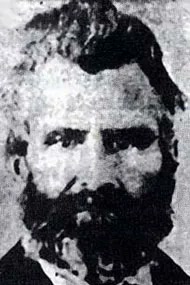
Daniel Montague was born on August 22, 1798, in South Hadley, Massachusetts. He arrived in Texas in 1837, in the Republic’s first year, and spent the next four decades surveying, soldiering, and serving in the state senate. He died on December 20, 1876. He never lived in the county that bears his name — but the county is his most lasting monument.
Who Was Daniel Montague?
Daniel Montague came to Texas as a trained surveyor, arriving in 1837 to find a republic whose most urgent practical need was exactly what he could provide. The Republic of Texas had just ended its war of independence, its land policies were in flux, and enormous tracts of north Texas were either uncharted or contested. Surveyors were not bureaucrats; they were frontiersmen who rode into Comanche territory with compass and chain, calculated boundaries under conditions of real physical danger, and opened land for legal settlement. Montague was among the most active in north Texas.
His professional base was the Fannin Land District, one of the early administrative subdivisions created to organize land surveys. As the district’s surveyor, he conducted the surveys that would eventually become the legal foundation for land ownership across a wide swath of north Texas. Through the compensation system of the era — surveyors were often paid partly in land — Montague accumulated substantial holdings across multiple counties including Cooke, Grayson, Collin, Fannin, and Montague.
The specific details of his surveying expeditions — the routes, the individual plats, the conditions encountered — remain largely in state archives and have not yet been fully examined at the research level available to this site. What is documented is that his professional output was substantial and well regarded.
What Was Daniel Montague’s Military Service?
Montague served in the Mexican-American War (1846–1848). The specific unit, rank, and campaigns he served in require primary-source verification beyond what is currently available here; the TSHA Handbook of Texas entry for Montague is the authoritative reference for those details. What is clear is that his military service added a second credential — veteran — to his surveyor and landholder profile, placing him alongside the cohort of men who defined mid-19th-century Texas leadership.
An early entry in his Texas record: in 1843, Montague was documented in what sources describe as the last known fight between Anglo settlers and Native Americans in Grayson County — a marker of the frontier conditions he navigated throughout his career in north Texas.
What Was His Political Career?
Montague was elected to the Texas Senate, adding a third credential that completed his public profile. The specific term dates, district, and committee assignments are documented in Texas Senate journals and in the TSHA Handbook; full detail requires primary-archival research beyond the current scope. He also served as Cooke County Commissioner in 1858 and 1862.
His senate service placed him at the center of Texas land policy at the exact moment when counties in north Texas were being created and named. The combination of surveying expertise, military service, and political standing made him exactly the kind of figure the Texas legislature honored by attaching his name to new counties.
How Did Montague County Get Its Name?
On December 24, 1857 — Christmas Eve — the Texas legislature created Montague County and named it for Daniel Montague. The county was formally organized in 1858.
The naming was an honor given during his lifetime: Montague lived until December 20, 1876, eighteen years after the county bearing his name was organized. He outlasted the raw frontier period that had defined his surveying career and died in the same year as the England family murders in Montague County — events that were themselves a last violent echo of the frontier era he had helped open.
The naming pattern was standard for mid-19th-century Texas: counties were frequently named for prominent Texans whose careers had served the state broadly, whether or not they had specific residential ties to the named county. Daniel Montague’s recognition was for his surveying of north Texas, his military service, and his political career — not for any specific settlement or institution he built in what would become Montague County.
One critical clarification: Daniel Montague did not live in Montague County. His operations, landholdings, and residence were in the Cooke County area and across north Texas. His MoCo connection is honorific rather than residential.
What Is Daniel Montague’s Legacy?
Montague’s name attaches to three things: the county, the county seat town of Montague, and — more diffusely — the historical memory of north Texas surveying. No major monument or museum is specifically dedicated to him. The county name itself is the principal memorial.
The TSHA Handbook of Texas entry for Daniel Montague is the standard biographical reference and is the recommended starting point for anyone researching his career in depth. Texas state archives and Senate journals hold the primary records of his political service; land records document his surveys; Texas State Library and Archives hold materials relevant to his surveying career.
His story is the story of a founding generation of Texas professionals: trained, mobile, risk-tolerant men who arrived in a new republic and shaped it through technical expertise and political participation. The county named for him on December 24, 1857 is still here.
Specific details of Daniel Montague’s Mexican-American War service (unit and rank), Texas Senate term particulars, full family genealogy, and surviving personal papers or photographs require primary-archival research beyond what is currently available. The TSHA Handbook of Texas is the authoritative secondary source.
See also: Montague (town) | People of Montague County