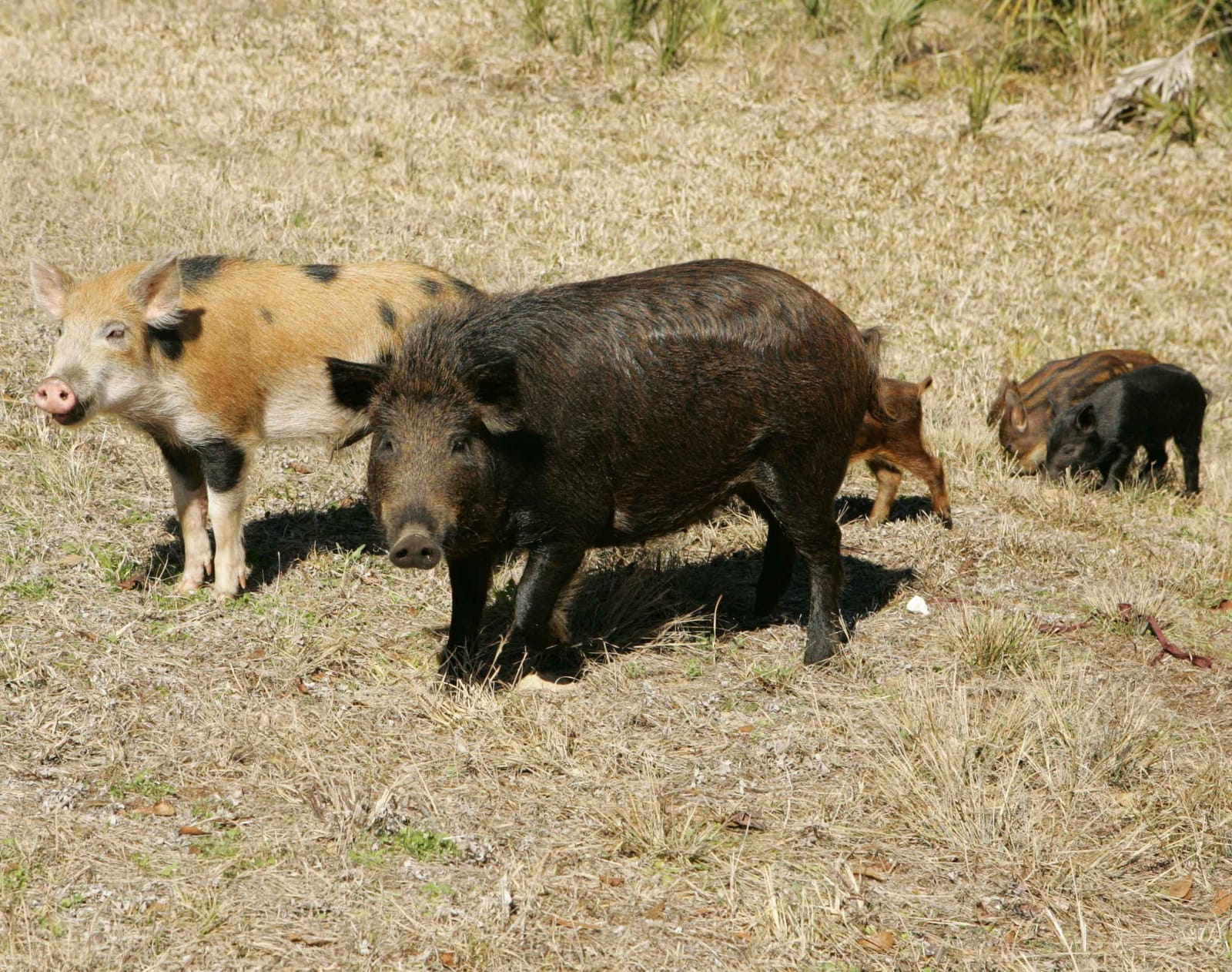
Drive any gravel road in Montague County at first light and you’ll see the evidence before you see the animals — long gouged rooting lines through the pasture grass, wallows torn into stock-tank banks, fence posts pushed out of the ground by 200-pound shoulders moving in the dark. The feral hog arrived in this county within living memory. It is not leaving.
Texas hosts somewhere between two and four million feral hogs, with statewide annual growth that requires removing roughly 70 percent of the population just to hold numbers steady. Montague County participates in both the population explosion and the rearguard fight against it. Hog presence is countywide; heaviest concentrations run through the creek-bottom corridors — Salt Creek, Farmers Creek, Denton Creek, the Red River bottoms — where brush and water give sounders of four to twenty animals the cover they need.
How Did Feral Hogs Get Here?
The history of feral hogs in Texas is layered. Spanish colonial explorers and missionaries introduced domestic pigs in the 16th and 17th centuries; some escaped, some were intentionally turned loose to provide future food supplies. Anglo-American frontier homesteaders brought more domestic stock; escaped pigs established feral populations across east and central Texas. In the 20th century, Eurasian wild boar (Sus scrofa) were introduced at some Texas locations for sport hunting and hybridized with the existing feral stock. More recently — and illegally — hogs have been transported across the state to seed new populations for hunting.
By 2010 the species was effectively statewide. Montague County had feral hogs by the 1980s and 1990s; populations have grown steadily since.
The animal that results from this mixed heritage is neither the domestic pig nor the European wild boar — it is a hybridized, behaviorally sophisticated invasive that carries traits from both lineages: the reproductive capacity of domestics, the wariness and physicality of wild boar, and the adaptability of a generalist that handles Texas heat, Cross Timbers brush, and Red River bottomlands with equal ease.
Why Feral Hogs Cannot Be Controlled the Way Deer Can
The biological profile of feral hogs makes them uniquely difficult to suppress. A doe can produce two fawns per year after reaching maturity at about 18 months. A sow can breed at six months, produce four to eight piglets per litter, and have one to two litters per year. Under good conditions, a single sow can produce more than 500 descendants in five years. Standard hunting pressure — even intensive pressure — cannot come close to matching that reproduction rate.
No natural predator in Texas significantly checks adult hog populations. Coyotes occasionally take small piglets. That is the limit. The apex predators that might have affected hog populations — wolves, mountain lions — were eliminated from north-central Texas by 1900. The hog occupies an ecological vacancy with no ceiling on its numbers.
Beyond reproduction, feral hogs are genuinely intelligent. They learn trap locations. They pattern hunter activity. They shift feeding grounds in response to pressure. A sounder that has been trapped once will avoid that style of trap. This adaptive behavior is one reason hog control requires sustained, varied effort rather than a single campaign.
What Feral Hogs Cost Montague County Landowners
Pasture and Hay Fields
Rooting is the primary agricultural damage vector. Hogs tear up pasture grass seeking roots, grubs, and tubers, leaving the surface with the texture of a plowed field. Damaged grass requires replanting and time to recover — time during which the land carries fewer cattle. In hay fields, rooting destroys hay quality and creates hidden ruts that can damage harvesting equipment when mowers hit them at speed.
Row Crops
Corn, milo, peanuts, and watermelons are especially vulnerable. Hog damage to a watermelon crop — a significant component of Forestburg-area agriculture — is direct and rapid; a sounder moving through a field overnight can destroy what took a season to grow.
Pecan Orchards
Hogs eat pecans on the ground, reducing harvest yields in commercial operations and native pecan groves alike. The Red River bottomlands of MoCo contain productive native pecan groves; hog pressure on those bottoms is heavy and documented.
Water Infrastructure
Wallowing in stock tanks fouls water quality, breaks down earthen tank banks, and accelerates sedimentation. A sounder using a stock tank repeatedly can render it unusable for cattle.
Fencing and Roads
Adult hogs can weigh 150 to 250 pounds or more. They push under, through, and over fencing that was adequate for domestic livestock. They root under fence lines, undermining posts. Replacing and repairing hog-damaged fencing is a recurring cost on actively managed land.
Vehicle collisions with hogs are increasing on rural roads, particularly at dawn and dusk. A large adult hog hitting the front of a vehicle at highway speed can total the vehicle and injure occupants.
Ecological Damage
The agricultural losses are only half the picture. Hogs compete directly with deer and wild turkeys for mast crops — acorns, pecans — that are critical wildlife food. They destroy the nests of bobwhite quail, wild turkeys, mourning doves, and songbirds on the ground. Their rooting disrupts soil structure, increases erosion, and eliminates native plant cover. Riparian areas where hogs wallow and feed heavily suffer vegetation loss and increased sediment loads in adjacent water.
The Texas Department of Agriculture estimates statewide hog damage at more than $50 million per year in agricultural losses alone, with additional millions in ecological and infrastructure costs. County-level figures for Montague County are not publicly reported, but the regional pattern applies fully.
Control Methods
Hunting
Texas allows year-round hog hunting with no closed season and no bag limit. A hunting license is required for non-landowners. The methods available — stand hunting, spot-and-stalk, dog hunting, helicopter operations, thermal night-vision hunting — cover most of the tactical options.
The honest accounting: hunting alone cannot control hog populations. Effective annual removal would need to exceed 70 percent of the local population; hunting typically achieves 20 to 30 percent. Hunting reduces damage on managed properties and fills hunting interest in the shoulder seasons between deer and dove, but it does not bend the population curve at the county or state scale.
Thermal night-vision hunting has become a significant subculture and a commercial offering in north Texas. Outfitters run guided thermal hunts that allow hunters to locate and engage sounders in complete darkness. Helicopter operations — where gunners engage hogs from the air — are legal in Texas with appropriate permits, effective in open country, and costly (typically $250 to $500 per hour). Neither approach is within reach of the average landowner’s budget.
Trapping
Trapping is the most cost-effective control method per acre of effort. Corral traps baited with corn or fermented grain are the standard approach. The critical advancement in recent years is cellular-monitoring trap technology: cameras and remote-trigger door systems that allow the trapper to see an entire sounder enter the trap before triggering the door. This removes the tactical disadvantage of traditional traps, which typically caught only the first animals to enter.
Texas A&M’s Natural Resources Institute and AgriLife Extension maintain research and outreach programs on trap design and bait strategies. The USDA Wildlife Services program operates in Texas and provides landowner-assistance trapping; their activity in Montague County is intermittent and request-driven.
Coordinated Landscape Control
The most effective hog management approach is coordinated effort across multiple landowners — trapping and hunting simultaneously across a geographic area, with shared data and timing. Sounders cross property boundaries freely; a control effort on one ranch that pushes hogs onto the neighbor’s land accomplishes little at the landscape scale. MoCo has no formal countywide coordination program publicly documented as of 2026, though individual ranches and Wildlife Services may collaborate informally.
The Realistic Outlook
Feral hog control in Montague County faces a basic biological constraint: the population’s growth rate exceeds what current tools can remove at scale. Absent a step-change technology — an effective broad-area toxicant, a viable biological control agent — the species is permanently established in the county.
The realistic goal for an MoCo landowner is to trap, shoot, and remove hogs aggressively enough to reduce damage on their own property; coordinate with neighbors when possible; and accept that county-level elimination is not achievable with current tools. The hog’s presence in the county is now as structural as the county’s deer and dove populations — a permanent feature of the rural landscape that land managers work around and against, season after season, without prospect of a final resolution.
Related pages: Native Mammals of Montague County · Hunting and Fishing in Montague County · Native Birds of Montague County
Sources: TPWD Wild Pigs; Texas A&M AgriLife Extension feral hog management; Texas Department of Agriculture. Statewide biology and regulations are well-documented in these sources. MoCo-specific population estimates and local trapping cooperative status remain outstanding research questions.