Montague County sits at a biological crossroads. Eastern woodland species push west from the post-oak forests; western prairie species push east from the rolling plains; aquatic species track the Red River corridor and the stock-tank network that dots every pasture. The result is a herpetofauna — the collective term for reptiles and amphibians — richer than anything strictly east or strictly west of the county would produce on its own.
The Texas horned lizard (Phrynosoma cornutum), the state reptile, is perhaps MoCo’s most recognized herp. Once common across every sandy pasture, it has declined sharply as red harvester ants — its primary food source — have been reduced by fire-ant invasion and broad-spectrum pesticide use. Sightings still occur in the county’s western and sandier reaches, but a horned lizard in a Montague County yard is now a notable event rather than a routine summer morning.
Lizards
The Texas spiny lizard (Sceloporus olivaceus) is the lizard that most MoCo residents see every day. Gray-green, 8–12 inches, it moves rapidly up tree trunks and fence posts and watches from above with detached alertness. It is the signature lizard of the Cross Timbers.
The six-lined racerunner (Aspidoscelis sexlineatus) is the open-country counterpart — fast, striped, running across sandy ground with bursts of speed that leave most observers sure they imagined it. Eastern fence lizards, broad-headed skinks (blue-tailed juveniles), ground skinks under leaf litter, and — around towns — the non-native Mediterranean house gecko complete the common lizard picture.
In rocky uplands and the western county, the eastern collared lizard (Crotaphytus collaris) appears: a striking animal, males showing blue-green and yellow with bold black collar bands. It perches on rocks and, when startled, runs bipedally. It’s worth the drive to the county’s limestone outcrops to find one.
Snakes — the Non-Venomous Majority
The vast majority of MoCo snakes are harmless. The Texas rat snake (also called chicken snake, Pantherophis obsoletus lindheimeri) is the large, common snake of barns, attics, and trees — 4 to 6 feet, a rodent predator that earns its keep in any farm setting. The bullsnake (Pituophis catenifer sayi) is the prairie counterpart: thick, yellow-and-brown, and prone to loud hissing and tail-vibrating when threatened. People who haven’t seen one before sometimes take the performance for a rattlesnake; the bullsnake has no rattle and no pit between eye and nostril.
Water snakes (Nerodia spp.) are the most routinely misidentified snakes in the county. Non-venomous, blotched, and heavy-bodied, they bask near stock tanks and creek edges. The actual cottonmouth (Agkistrodon piscivorus) prefers slower, more permanent water and is considerably less common in MoCo’s reach than water snakes. Key distinction: water snakes have round pupils, swim with their bodies mostly submerged, and flee when approached. Cottonmouths have vertical pupils, float with bodies high on the water surface, and gape their mouths to show the white interior when cornered.
The speckled kingsnake (Lampropeltis getula) is immune to pit-viper venom and actively hunts rattlesnakes. Killing one is counterproductive.
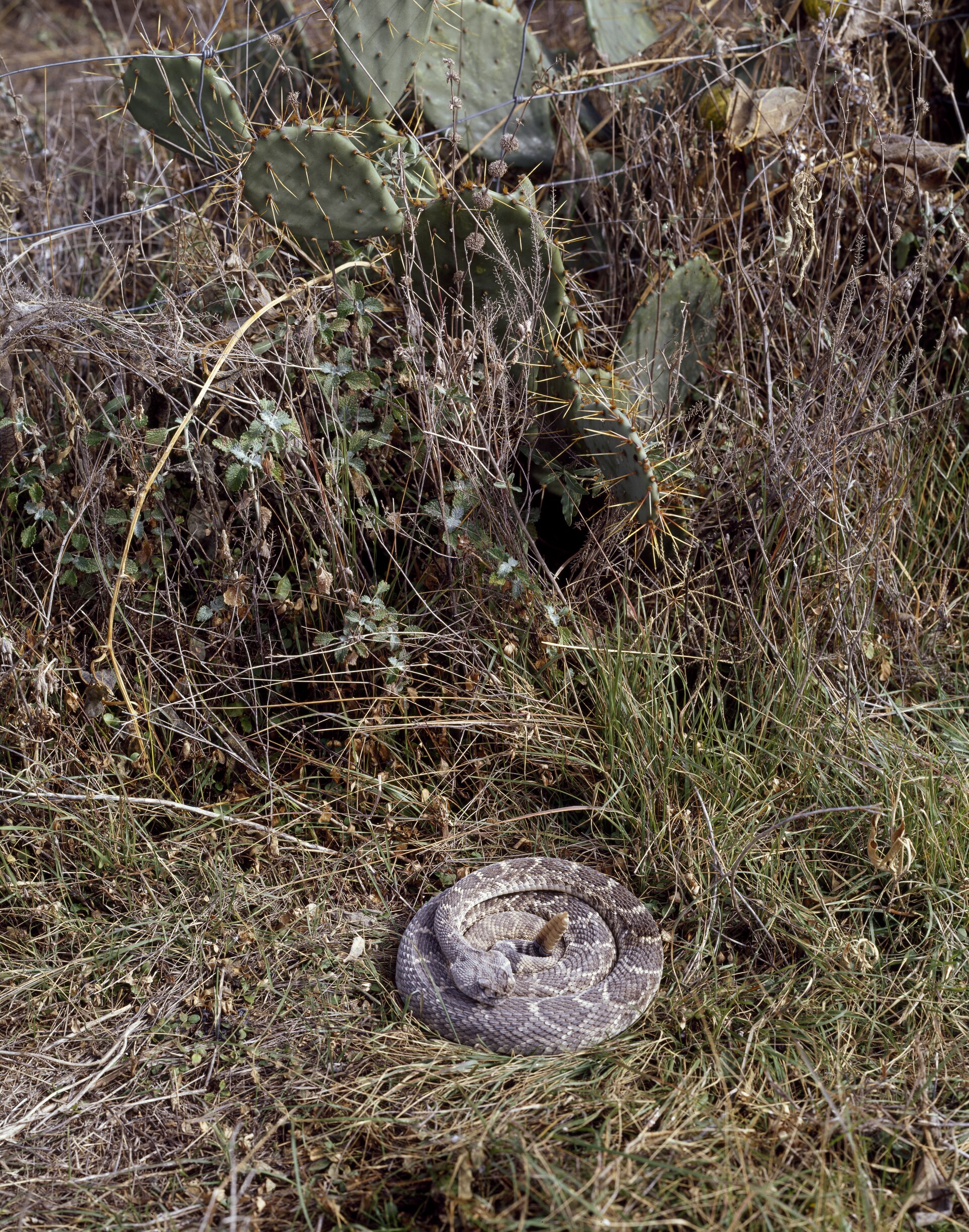
For venomous species — western diamondback rattlesnake, copperhead, cottonmouth, and the less common massasauga and timber rattler — the research record is covered in the companion file on venomous snakes.
Turtles
The red-eared slider (Trachemys scripta elegans) occupies nearly every pond, lake, and slow stretch of water in the county. Snapping turtles (Chelydra serpentina) are present wherever snapping turtles have suitable water; they are large, aggressive when encountered on land (they feel exposed and cornered), and best given a wide berth.
The Red River and its tributary creeks hold Texas spiny softshell turtles (Apalone spinifera emoryi) — flat, leathery-shelled animals that bury themselves in sandy river bottoms and breathe through their skin in addition to their lungs. The common box turtle and ornate box turtle (Terrapene spp.) are the county’s terrestrial turtles. Both are declining across their range from road mortality, habitat loss, and pet-trade collecting. They are protected under Texas law; collecting is prohibited.
The alligator snapping turtle (Macrochelys temminckii) may have been historical in the Red River reach of MoCo; current population status is uncertain.
Amphibians — Frogs, Toads, and Salamanders
The stock-tank culture of north Texas is good for amphibians. Toads — Texas toad, Woodhouse’s toad, Gulf Coast toad, Great Plains toad — aggregate around porch lights in summer, eating insects, and breed explosively after spring rains. The spadefoot toad (Spea bombifrons) is a specialist: it spends most of the year buried deep in the soil, emerging only when heavy rains create temporary ponds. Its breeding choruses, triggered by a single big storm event, can be deafeningly loud for two or three nights and then silent for months.
Bullfrogs (Lithobates catesbeianus) occupy permanent water — lakes, stock tanks, slow pools. Leopard frogs appear at pond edges; cricket frogs (Acris spp.) provide the quick metallic clicking that underlies every summer evening near water. Gray treefrogs call from trees in summer, a distinctive nasal trill heard more often than the animal is seen.
Salamanders are sparse in the county’s relatively dry climate. The smallmouth salamander (Ambystoma texanum) is possible in moist bottomland habitat, but the rich salamander diversity of East Texas is absent here.
Habitat Summary
| Habitat | Signature species |
|---|---|
| Post-oak woodland | Texas spiny lizard, rat snake, broad-headed skink, gray treefrog |
| Open prairie | Six-lined racerunner, horned lizard, bullsnake, coachwhip |
| Rocky outcrops | Collared lizard, prairie lizard, massasauga |
| Stock tanks and ponds | Red-eared slider, bullfrog, leopard frog, water snakes |
| Red River and creeks | Softshell turtles, snapping turtles, water snakes, bullfrog |
| Towns and yards | Mediterranean gecko, spiny lizard, occasional rat snake |
Conservation Notes
Texas horned lizards and box turtles are protected from collection in Texas. The alligator snapping turtle carries state and federal protections. For most other species, the greatest threats are road mortality, habitat loss, and direct persecution — particularly of snakes, which are still routinely killed on sight despite their ecological value as rodent controllers and in some cases as rattlesnake predators.
Montague County’s herpetofauna is a reliable indicator of land-use health. Declining horned lizards signal a red-harvester-ant problem, itself signaling pesticide or fire-ant invasion. Abundant cricket frogs and toad choruses mean the stock-tank network is healthy. Water snakes present means the creek system is fishable. Pay attention to what you see in a normal week outdoors, and the county’s ecological condition starts to read itself.
See also: native birds and native mammals for the fuller Cross Timbers wildlife picture.