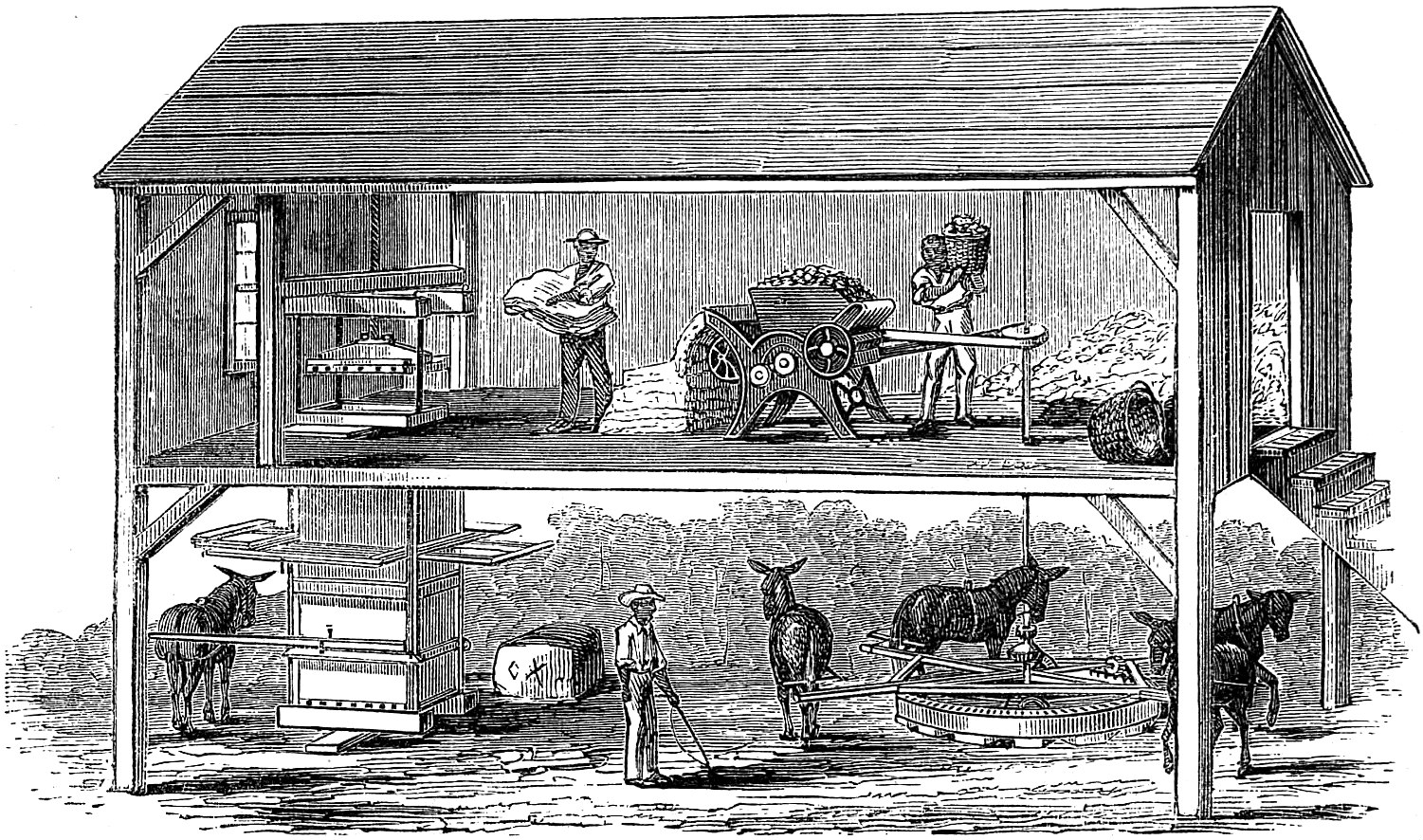
The cotton gin was not a dramatic piece of equipment. It sat inside a wood-frame or brick building, ran on steam and later electricity, made considerable noise during operation, and produced one straightforward output: bales of cotton fiber, compressed and ready for rail shipment. What made it consequential was its position in the agricultural economy. Without the gin, cotton was unsalable. With the gin, cotton was money. In Montague County at peak in 1914, forty cotton gins turned 43,595 bales of seed cotton into the compressed lint that fed eastern and international textile mills. Each gin was also an economic anchor — a reason for a community to exist, a social gathering point during harvest season, and the physical landmark that told a farm family where to haul their crop.
Gin Infrastructure
The cotton gin’s core function — separating cotton fiber from seeds — had been mechanized since Eli Whitney’s 1794 patent. Whitney’s original wire-tooth cylinder design launched the industrial cotton economy of the American South. By the time MoCo’s gins were operating at peak in the 1900s–1910s, the technology had evolved substantially:
- Steam-powered, transitioning to electric power by the mid-20th century
- Multiple gin stands operating in parallel for high-volume throughput
- Pneumatic conveyor systems moving raw seed cotton from farm wagons into the gin
- Dryers and cleaners preceding the gin stands to improve fiber quality
- Condensers and presses downstream, forming the 500-pound gin bale
- Cottonseed handling systems separating the seeds for separate sale as oil feedstock or livestock feed
A farmer arriving at the gin yard in fall harvest season would weigh the seed cotton on the wagon scale at the entrance, wait in a line of similar wagons (lines that stretched down the road during peak picking weeks), and receive a gin ticket documenting the weight and cotton grade when the ginning was complete. That ticket, converted to a bale price, settled against the merchant’s crop lien at season’s end.
The gin season ran from early September through November, often twenty-four hours a day during peak harvest weeks. The gin yard was crowded with wagons, loud with machinery, dusty with cotton lint, and — for the farmers waiting their turn — a primary source of community news and social exchange. The smell of ginning cotton, a combination of fiber dust, machine oil, hot drive belts, and drying cotton, remained in the memory of people who experienced it for the rest of their lives.
Why Forty Gins
The distribution of forty gins across Montague County reflected the economics and logistics of the wagon-era cotton economy. Horse-drawn wagons could haul seed cotton a reasonable round-trip distance of five to fifteen miles. To serve a county of 25,000+ residents populating roughly 900 square miles of cotton country, gins had to be distributed across communities rather than concentrated in a single location. The geography dictated a dispersed infrastructure.
Major concentrations:
- Bowie — multiple gins in the principal rail and commerce town; also hosted the cotton compress facility
- Nocona — multiple gins serving the northern county
- Saint Jo — gins for the western county
- Sunset — documented as having two cotton gins at peak
- Forestburg — community gin serving the southeastern county
Beyond these named centers, gins operated at crossroads communities across the county — Stoneburg, Hardy, Ringgold, Belcherville, and smaller settlements that have largely disappeared from current maps. A complete inventory of gin locations, operators, and histories requires primary research at the county clerk’s office, USDA Cotton Division historical records, and local newspaper archives from the period.
A typical country gin processed between 1,000 and 3,000 bales per season. With forty active gins and 43,595 bales at peak, average throughput ran to roughly 1,090 bales per gin — consistent with those capacity figures, and suggesting that most gins operated close to capacity during the peak harvest weeks.
The Bowie Cotton Compress
Beyond the forty gins, Bowie hosted a cotton compress — a distinct facility that further processed bales for rail shipment. Gin bales left the country gin at approximately 500 pounds. The compress received those bales and recompressed them to approximately 700 pounds of higher density, fitting more cotton into each rail boxcar and reducing shipping costs to eastern mills.
The compress required direct rail access — Bowie’s position at the Fort Worth and Denver Railway junction made it the logical location. Cotton compressed at Bowie moved by rail to textile mills in the eastern United States and, through port connections, to English and European mills that consumed Texas cotton at scale through the peak production years.
The compress was a significant employer and economic anchor. During ginning season, the Bowie compress operated continuously. Wagons and later trucks delivered gin bales from across the county; the compressed bales departed by rail. The facility’s direct connection to global textile markets — a transaction that began when a tenant farmer planted cotton in a sandy-loam field somewhere in the county’s interior — made Bowie’s position as the county’s commercial center during the cotton era concrete.
Cottonseed and Byproducts
The cotton bole contained two commercial products: the fiber and the seed. Cottonseed, collected by the gin as a byproduct of fiber separation, had substantial value:
- Cottonseed oil pressed for use in margarine, shortening, soap, and industrial lubricants
- Cottonseed meal and cake — the residual after oil extraction — used as livestock protein supplement
- Cottonseed hulls as roughage and fertilizer feedstock
- Planting seed retained for next year’s crop, with better gin operators selecting for variety quality
Cottonseed oil mills were not located in MoCo; local seed was shipped to regional mills. But the cottonseed trade added a meaningful secondary revenue stream to gin operations, and cottonseed meal returned to MoCo as livestock feed — the byproduct of one agricultural system supplying inputs to the cattle system that ultimately replaced it.
Decline
The boll weevil’s arrival around 1910 began the long contraction. As cotton volume dropped, gins processed fewer bales. Marginal country gins — serving communities where cotton acreage was falling fastest, with older equipment and thinner capital — closed first.
Through the 1920s and 1930s, the pattern was steady reduction:
- 40 gins at 1914 peak
- Progressive closures as volume declined and cotton acreage contracted
- Surviving gins often shifted to grain processing during off-season or between increasingly shorter cotton seasons
- The most competitive gins — better location, more modern equipment, more capital — lasted longest
By mid-20th century, a handful of MoCo gins persisted. By the time the county had largely transitioned to cattle, hay, and fruit as its agricultural base, no economically significant cotton ginning remained. Modern cotton ginning in Texas consolidated regionally into large industrial facilities on the High Plains; MoCo’s small residual cotton acreage, where any survived, moved to gins in adjacent counties.
No active cotton gins operate in Montague County today.
What Remains
Cotton gin structures were built predominantly in wood frame, with some brick construction and later metal cladding. Wood-frame gin buildings decayed, burned, or were demolished for salvage lumber within decades of closure. Brick structures fared better, with some repurposed as warehouses, storage buildings, or simply left to deteriorate.
Physical evidence of the forty-gin era:
- Concrete pads and foundations — sometimes visible in overgrown locations along former gin roads
- Brick remnants — occasional surviving walls of more substantial structures
- “Gin road” and “cotton road” place names — persisting in county road designations and family references even after the buildings disappeared
- Photographs — the Portal to Texas History and the Tales ‘N’ Trails Museum in Bowie hold period photographs documenting gin yards, wagon lines, and the harvest-season activity that surrounded them
The museum-quality collection of gin-era artifacts — gin stands, press equipment, gin tickets, account books — would require primary research to inventory across MoCo’s local museums and family collections.
Memory
The gin is present in the memory of MoCo residents old enough to have experienced it, or to have heard accounts from those who did. The waiting lines at gin yards during harvest. The seasonal employment of gin workers who needed other work from December through August. The gin operator as a community figure — often the same person who ran the country store, extended the crop lien, and determined what a family’s cotton was worth.
The smell of ginning cotton — that specific combination of lint, heat, and machinery — is a sensory marker that appears in oral histories and family memoirs as a reliable index of what the cotton era actually felt like from the inside. It is not a smell available in any MoCo gin today. The last operational gin is within living memory for some residents; within two or three decades, the direct sensory memory will be gone entirely.
Related pages: The Cotton Era in Montague County · The Boll Weevil Crisis · The Dust Bowl and Great Depression · Cattle-Cotton-Oil Era Index
Sources: TSHA Handbook of Texas (Cotton Gins entry). General gin count (40 at 1914 peak) confirmed against cotton-era.md and TSHA data. Specific named MoCo gin locations, operators, and inventory have not been documented in available sources and require Montague County Clerk records, USDA Cotton Division historical files, and local newspaper archive research.