In the winter of 1863, Montague County’s frontier settlements were as exposed as they had ever been. Confederate conscription had emptied homesteads of military-aged men. The Texas Frontier Regiment — the state militia tasked with holding the raid line — was undermanned and poorly supplied. And on the nights of December 21 and 22, a force of approximately 250 Kiowa and Comanche warriors crossed the Red River from Indian Territory and swept through the Illinois Bend community on the Montague-Cooke County boundary, killing at least a dozen settlers, taking captives, and driving off livestock. The raids did not stop after that December. But that December was the moment the frontier’s vulnerability became impossible to ignore.
Source note: Accounts below draw on Anglo-settler records. Tribal consultation pending — Kiowa and Comanche oral tradition on this event has not been incorporated; perspectives from the Kiowa Tribe of Oklahoma and Comanche Nation would complement the settler record.
What Was Happening in Texas in December 1863?
By the middle of the Civil War, the logic that had kept a fragile peace on the Texas frontier had broken down. The US Army’s frontier forts — the chain of posts that had given settlers some buffer against large-scale raiding — had been abandoned when Texas seceded in March 1861, their federal garrisons withdrawn to Union service. The Confederacy’s answer was the Texas Frontier Regiment, established by the state legislature in late 1861 with roughly 1,000 mounted men spread across the entire western settlement line. It was not enough.
In Montague County, the regiment maintained Red River Station, a post about nine miles northwest of modern Nocona. The station watched the Red River crossings in that corridor and provided patrols through the region. But the frontier line was too long, the patrols too sparse, and the raid-season pressure too intense. Confederate conscription was simultaneously pulling men eastward into the main Confederate armies, depleting both the regiment’s ranks and the county’s civilian defense capacity. Federal activity in Indian Territory was disrupting the agreements that had previously constrained the largest Comanche and Kiowa operations.
The combination created a window of vulnerability in the winter of 1863 that a raiding force of sufficient size could exploit — and one did.
What Happened at Illinois Bend in December 1863?
The Illinois Bend community occupied the Red River’s long eastward bend in the northeastern corner of Montague County, straddling the Montague-Cooke County line. Settlers had been farming the river bottoms here since roughly 1849, drawn by the richest agricultural ground in the county’s northeastern reach. By 1863 they knew the risk they were living with; the community maintained a fortified refuge — Fort Illinois Bend — where families could shelter when raid pressure intensified. In December 1863, the pressure exceeded anything a fortified homestead could answer.
The raiding force crossed from Indian Territory into the Illinois Bend area and moved through the dispersed homesteads in a pattern designed to prevent any farmstead from warning the next. The force numbered approximately 250 warriors, Kiowa and Comanche operating in a joint raid — the alliance between these two nations, formalized around 1790, meant that large operations routinely combined fighters from both. Anglo-Texan regional sources attribute command of the raid to a Kiowa leader called Big Tree.
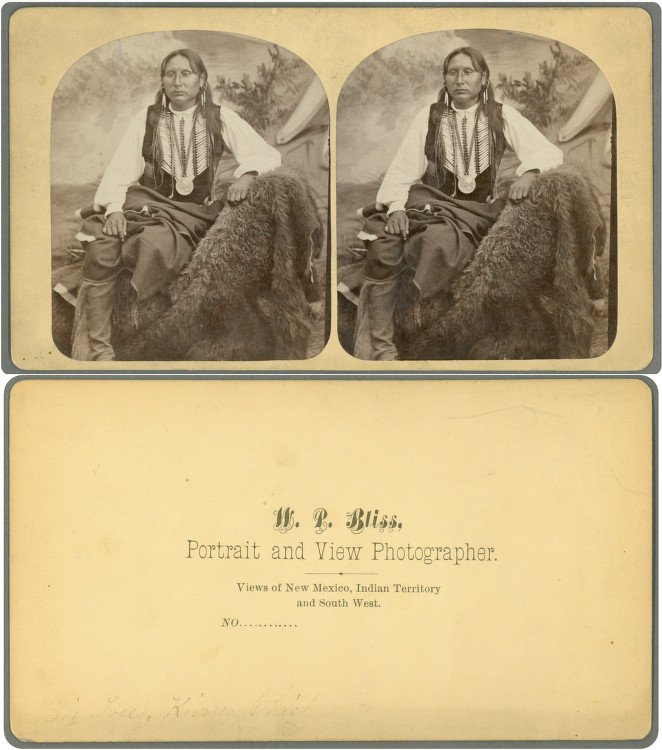
The figure most closely matching that name in the documented historical record is Adoeette — the Kiowa war chief whose English name translates as “Big Tree.” Adoeette (ca. 1838–1850 per varying sources; died November 13, 1929, Anadarko, Oklahoma) was a member of the Kaitsenko warrior society, the Kiowa’s elite fighting men, and was militarily active through the 1860s and into the 1870s. He became nationally known in 1871 when he was tried alongside Satanta at Jacksboro — the first civil-court prosecution of Indigenous leaders in Texas history — for his role in the Warren Wagon Train attack. Adoeette was Kiowa, not Comanche. Earlier accounts in some settler and synthesis sources misidentified his tribal affiliation; the correction is confirmed by the TSHA Handbook of Texas, the Kiowa Tribe of Oklahoma, and the Encyclopedia of Oklahoma History. Whether Adoeette specifically commanded the December 1863 Illinois Bend raid, or whether Anglo-Texan sources applied his name loosely to any major Kiowa raid leader, remains unsettled in published sources. Tribal consultation pending — Kiowa Tribe of Oklahoma perspectives on raid command attribution are not yet incorporated.
What is established is what happened across those two December days. The raid force attacked settlers in their dispersed farmsteads. At least twelve settlers were killed across the Illinois Bend area. Women and children were taken captive and removed north across the Red River into Indian Territory. Homesteads were burned. Horses, cattle, and stored provisions — the material foundation of frontier family life — were driven off or destroyed. Survivor accounts recorded by Mrs. W.R. Potter in her 1913 History of Montague County name multiple frontier-era family casualties, including the Wainscot, Moore, Box, Shegog, Parkhill, Fitzpatrick, McElroy, Leatherwood, Powers, Keenan, and Paschal families as among those affected by the raid period’s violence.
Who Was Ann Keenan?
Ann Keenan’s name is among those most closely associated with the Illinois Bend raid in regional historical memory. The question of when she died — and in which event — is one that the available sources do not resolve cleanly, and this page will not resolve it for you.
Some regional accounts connect Ann Keenan’s death to the December 1863 Illinois Bend raid. Other sources — genealogical records and regional documentation — place her death on September 5, 1870, in a separate Denton Creek ambush, along with a Mrs. Paschal. The current research treats 1870 as the more reliable date for these two deaths.
The conflict has not been resolved by primary source evidence. The designated resolution method is probate records and contemporary newspaper accounts at the Montague County Clerk’s office and Bowie Public Library — primary archival research that, as of this publication, has not been completed. Until that research is done, this page presents both dates and explains the conflict, because erasing one date to tell a cleaner story would misrepresent what the record actually contains.
What is not in dispute: Ann Keenan’s name is preserved in Montague County’s frontier-era memory as a casualty of the raid period’s violence. The specific event and date of her death require primary-source verification before any confident attribution can be published.
What Happened After the Raid?
Immediate aftermath
Survivors fled eastward to safer counties. The already-undermanned frontier defense forces increased their patrols, to limited effect. Confederate authorities in Austin promised reinforcements that arrived slowly if at all.
The 1867 evacuation
The December 1863 raid was not the last raid that struck Montague County. The pattern of violence — large raids punctuated by constant smaller parties targeting stock and isolated travelers — continued through 1864 and into the later 1860s. Each new incident confirmed what December 1863 had demonstrated: the frontier defense was broken.
By 1867, Montague County had been substantially evacuated. Most outlying farmsteads in the Illinois Bend area and elsewhere in the county’s northern tier were abandoned. Families concentrated in the few defensible positions that remained, or they left entirely. The population numbers tell the story in outline: the 1860 census counted 849 residents; the 1870 census found 890 — essentially flat over a decade that in theory should have seen growth. The flat number conceals a deeper trough, probably around 1867, when much of the county’s northern tier held almost no one.
Recovery after 1875
Resettlement did not begin in earnest until federal military action removed the raid-era threat. The Red River War of 1874 — a coordinated US Army campaign across the southern Plains — broke the military capacity of the Comanche and Kiowa nations. Colonel Ranald Mackenzie’s destruction of the horse herds and winter supplies at Palo Duro Canyon in September 1874 was the decisive blow. By 1875, Comanche and Kiowa peoples were confined to the Fort Sill reservation in Indian Territory. The raids stopped.
Within a few years, families were returning to the Illinois Bend bottoms. The community reached its historic peak of approximately 300 residents by 1885, with gristmills, cotton gins, a post office, and a school. The Illinois Bend Memorial Cemetery — whose earliest surviving marked grave dates to 1873 — was formally deeded as community burial ground in 1880.
Why Does This Raid Matter in the Larger Frontier Story?
The December 1863 Illinois Bend raid was not an isolated event. It was the largest documented single instance of a pattern that ran from roughly 1849 through 1875: Comanche and Kiowa raiding parties using the Red River crossings at Spanish Fort, Red River Station, and Illinois Bend to move south through the Cross Timbers prairie corridors and attack the settler communities below. The raid’s scale — 250 warriors operating deep in Texas — was exceptional; the underlying pattern was not.
What distinguished December 1863 was the Civil War context. The same federal vacuum that gave the raid its opening — the withdrawal of US Army forts, the depletion of the Frontier Regiment through Confederate conscription — also made recovery slower and the population effects deeper. The raid demonstrated, at scale and at cost, that Confederate Texas could not defend its own frontier while fighting a larger war.
From the Comanche and Kiowa perspective, the December 1863 raid was a successful military operation: significant losses inflicted on settler communities, captives and livestock taken, the raiding force returning home intact. The strategic aim — pressure on the settler frontier to reclaim territory — was tactically achieved. What neither the raid nor the sustained pressure that followed could alter was the demographic and military force building from the east. The reservation era began not with settler armies winning in the field but with the destruction of the bison herds that supported Plains life, and with federal military campaigns that outresourced any individual raid.
The Illinois Bend Today
The Illinois Bend community is today a small unincorporated settlement — approximately 30 residents as of the 2000 census — on FM 677 north of Saint Jo. The Illinois Bend Memorial Cemetery on Illinois Bend Road, roughly 14.3 miles north of Saint Jo, holds approximately 499 memorials and carries a Historic Texas Cemetery designation. A Texas Historical Commission marker erected in 2013 documents the community’s history — the original names Maxwell, Maxville, and Wardville; the Illinois Bend name’s derivation from the settlers’ home state; the 1880 Elliot land deed; the community’s founding and its tradition of a homecoming “graveyard working” day, held the first Saturday in August and later moved to April.
The marker does not address the December 1863 raid directly. No marker stands at any raid site; the specific locations of the homesteads attacked in December 1863 are not preserved in any publicly accessible documented form. The Comanche Nation and the Kiowa Tribe of Oklahoma hold the authoritative accounts of the raid from Indigenous perspectives; consultation with their cultural offices has not yet been undertaken.
Related pages: The Civil War on the Frontier · Comanche Raiding Routes Through Montague County · Big Tree (Adoeette) · Illinois Bend · Texas Rangers in Montague County
Sources: TSHA Handbook of Texas (“Adoeette,” “Illinois Bend, Texas”); Kiowa Tribe of Oklahoma, “Our History”; Encyclopedia of Oklahoma History and Culture (“Big Tree”); Mrs. W.R. Potter, History of Montague County (1913); THC historical marker at Illinois Bend Memorial Cemetery (2013). Kiowa and Comanche oral tradition on this event requires direct tribal consultation before it can be incorporated.