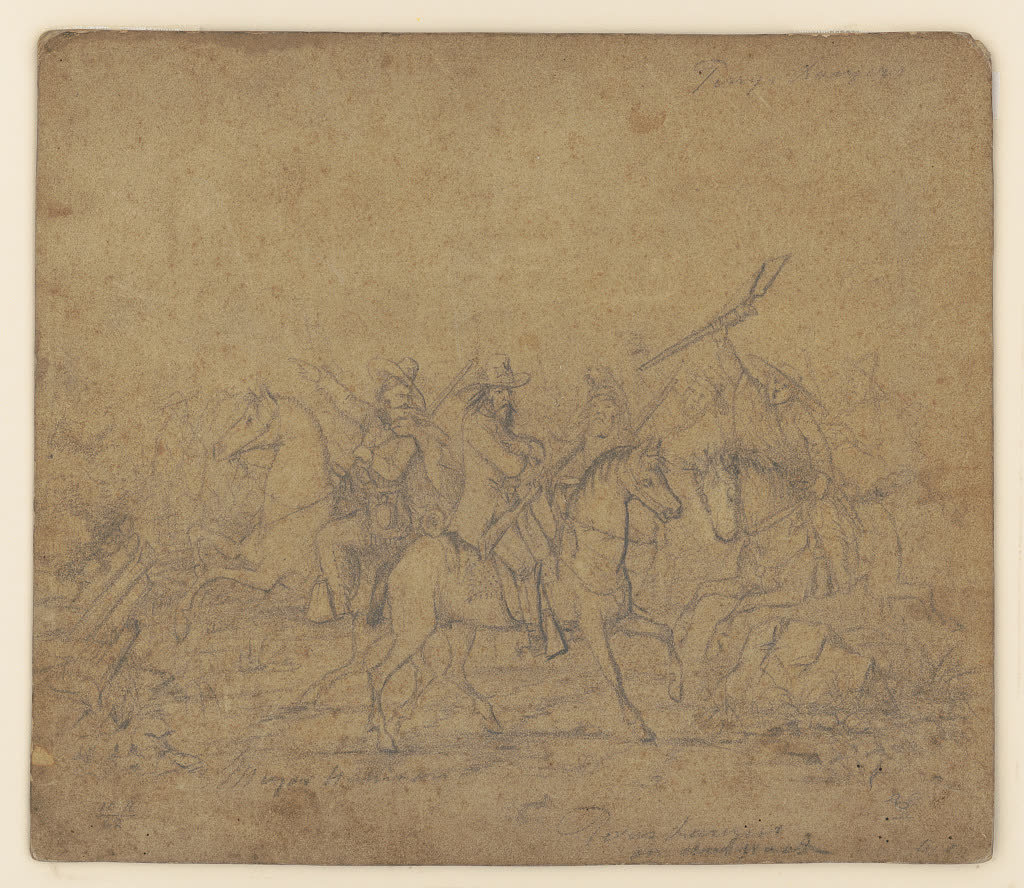
The Texas Rangers did not define Montague County the way they defined the counties further west where the frontier forts stood — there is no Fort Richardson in MoCo, no documented Ranger massacre in the county’s records, no single famous engagement that a heritage marker names. What the Rangers meant to Montague County was less dramatic and more structural: they were part of the general frontier defense architecture that sat — sometimes reliably, sometimes not — between settler families and the Comanche and Kiowa raid parties that crossed the Red River and moved south through the Cross Timbers corridors.
That architecture had gaps. The Civil War removed it almost entirely for four years. The Reconstruction era replaced it with a controversial substitute. It was not fully reconstituted until 1874, by which point the frontier threat it was designed to meet was already ending. The story of the Rangers in MoCo is partly the story of a defense institution that arrived in its most organized form just as the crisis it was built for was closing.
Who Were the Texas Rangers, and When Did They Begin?
The Texas Rangers trace to 1823, when empresario Stephen F. Austin authorized ten experienced frontiersmen as “rangers” for a punitive expedition against Indigenous attacks on his colony. The number is small; the institutional DNA is there. Through the Texas Republic period (1836–1845) and early statehood, the Rangers evolved into something distinctive — part state militia, part cavalry patrol, part law enforcement, part frontier scouts — combining functions that most American states kept in separate institutions.
By the 1850s, the Rangers had a recognizable institutional character. Their organization was variable: sometimes a permanent state force with legislative appropriation, sometimes ad hoc companies raised county-by-county when raids peaked, sometimes operating under federal contract as territorial peacekeepers. What was consistent was the operational model: small mounted units, long-range patrol capability, and authority to pursue threats across county lines and — in practice — sometimes across jurisdictional limits that federal law would not formally sanction.
Notable Ranger figures of the 1850s — John Coffee Hays, John S. “Rip” Ford, and others — operated across north Texas during this period, though their specific operations within Montague County’s modern boundaries are not documented in available sources at this tier. Montague County was not formally organized until 1857; operations before that date were across the broader north Texas region.
What Did the Rangers Do — and Fail to Do — Through the Civil War?
During the Civil War, the Rangers as a distinct institutional force largely dissolved into Confederate service and the Texas Frontier Regiment — the state militia that Texas created in 1861 specifically to hold the raid line while its military-age population was committed to the Confederate armies. The Frontier Regiment maintained Red River Station, a patrol post about nine miles northwest of modern Nocona, as one of its northernmost nodes in Montague County.
The Frontier Regiment performed a Ranger-adjacent role: mounted patrol, raid pursuit, and protection of crossing points. Many Regiment members had been Rangers before the war and would serve again in Ranger-like capacities after it. The personnel and the skills were continuous even when the institutional label was not.
What neither the Rangers nor the Frontier Regiment could prevent was the December 1863 Illinois Bend raid — the most catastrophic single Indigenous military action in the county’s documented history, when a force estimated at roughly 250 Kiowa and Comanche warriors swept through the Illinois Bend community on the Montague-Cooke County boundary, killing at least a dozen settlers and accelerating what became the near-evacuation of the county by 1867. The Red River Station post was within the general patrol area; it did not intercept the raid. The frontier line was too long, the patrols too sparse, and a force of 250 warriors moved through what the post could watch.
Why Was There a Rangers Gap During Reconstruction?
From 1865 through 1874, the Texas Rangers as a formal independent force did not operate in their traditional form. Federal Reconstruction authorities suppressed independent Texas state forces that could have been used to resist federal occupation. The Texas State Police (1870–1873) — a Reconstruction-era law-enforcement body created by the Republican state government — partially substituted, operating as an integrated force with significant African American officers and a mission that included civil rights enforcement as well as ordinary law enforcement.
The State Police was deeply unpopular in former-Confederate communities, including most of north-central Texas. Its effectiveness was mixed: documented successes against outlaw activity coexisted with documented abuses and strong community resistance. When Democratic Governor Richard Coke took office in January 1874, the State Police was disbanded almost immediately.
Throughout this Reconstruction gap — roughly 1865 to 1874 — frontier raid pressure in Montague County continued without the formal Ranger presence that had provided some defense before the war. Federal Army units, including Buffalo Soldiers (African American 9th and 10th Cavalry) stationed at western posts, operated against Comanche and Kiowa forces from forts further west. Their operations were aimed at the broader campaign to confine Plains peoples to reservations, not specifically at protecting Montague County settlers. Local community defense — watch rotations, fortified structures, mutual-aid pursuit — remained the practical first line.
What Was the Frontier Battalion?
The Texas Frontier Battalion was established in 1874 as a reorganized Ranger force, ending the decade-long gap. The TSHA Handbook confirms: “The Frontier Battalion, composed of six companies of Texas Rangers of seventy-five men each, was organized in 1874.” Six companies at 75 men each totaled approximately 450 men — the largest and most systematically organized Ranger force in the state’s history to that point.
The Battalion was distributed across the Texas frontier line, with companies stationed at various points from the Red River south. Montague County would have been within the patrol range of one or more companies — which specific company designations covered MoCo, and which named Rangers served in those companies, requires primary archival research at the Texas State Library or the Texas Ranger Hall of Fame archives in Waco. That detail is not available in published sources at this tier.
What is established is the timing: the Frontier Battalion arrived just as the frontier threat was ending. The Red River War of 1874 — a coordinated US Army campaign — broke organized Comanche-Kiowa resistance at Palo Duro Canyon in September 1874. By June 1875, the last Quahadi Comanche bands had surrendered. The Battalion’s companies arrived ready for active frontier defense and found the frontier quieting.
That was not a failure of the institution — it was the institution working as designed, in coordination with the Army campaign. The Rangers provided the state-level component of a multi-force effort that finally broke the three-decade raid pattern.
What Did the Rangers Do in MoCo After the Raids Ended?
Once the Comanche-Kiowa raid threat effectively ended by 1876, Ranger operations in and through Montague County shifted focus. The post-raid mission involved:
Outlaw pursuit. The north Texas outlaw economy of the late 1870s and 1880s — cattle thieves, bank robbers, fugitives crossing county lines — fell within the Rangers’ statewide jurisdiction. Rangers operating through north Texas would have passed through MoCo in pursuit of specific targets and conducted patrol operations aimed at the organized rustling and robbery activity documented in regional records. Specific named Ranger pursuits of MoCo-connected outlaws require primary-source verification.
Cattle theft suppression. Livestock theft across the Red River — cattle and horses crossing into Indian Territory — remained a significant criminal pattern through the late 1870s. Rangers with statewide authority could pursue cases that county sheriffs could not follow beyond jurisdictional lines.
Local law-enforcement support. The Rangers’ role as a state-level force meant they could be called into MoCo when local law enforcement was inadequate — for difficult arrests, for multi-county criminal operations, or simply as a deterrent presence. The England family murder case of 1876 — four members of a Montague County family killed, eventually resolved through five trials and three life sentences — was handled through the county court system rather than through Ranger intervention, but it demonstrates the formal legal order that the Rangers’ presence helped sustain.
Tonkawa scout connection. Rangers of the frontier era sometimes operated with Tonkawa scouts — Indigenous men whose hostility toward Comanche and skill at trail reading made them valuable to mounted operations. The Tonkawa’s role in supporting Anglo forces against other Indigenous peoples is a complicated chapter in the region’s history; it is documented in the caddo-and-tonkawa spoke.
What Is the Rangers’ Legacy in Montague County?
The Texas Rangers occupy a contested place in Texas historical memory — celebrated in one tradition as frontier heroes, critically reassessed in another for documented violence against Mexican-American Tejano communities, for the 1918 Porvenir massacre in Presidio County (far from MoCo but part of the institutional record), and for their role as enforcers of Anglo political dominance throughout the 19th and early 20th centuries.
For Montague County specifically, the Ranger story is predominantly the frontier-defense thread rather than the Tejano-violence thread. MoCo’s small Hispanic population and its position within the north Texas Anglo-settler world meant that Ranger-Tejano conflicts documented in south Texas had limited direct MoCo analog. The Raiders who threatened MoCo were Comanche and Kiowa, not Mexican or Tejano, and the Rangers’ operations against them are the primary record.
What MoCo’s Ranger history illustrates is how difficult it was, through the 1840s to 1870s, to build a reliable defense system for a frontier county that was simultaneously remote from state government, under fiscal constraint, politically disrupted by Civil War and Reconstruction, and facing one of the most sustained and effective Indigenous resistance campaigns in 19th-century North America. The Rangers were part of the answer — an imperfect, intermittent, sometimes brutal answer, but part of the institutional framework that eventually enabled stable settlement.
The Rangers Hall of Fame and Museum in Waco holds significant archival material on frontier-era Ranger operations. Primary-source research there — alongside the Texas State Library and Archives — would likely yield specific company assignments, patrol records, and named Ranger figures with MoCo connections that the available published record does not yet provide.
Related Pages
- Comanche Raiding Routes Through Montague County — the tactical geography the Rangers were designed to counter
- Reconstruction-Era Violence in Montague County — the 1865–1876 disorder the Rangers partially addressed
- The 1863 Illinois Bend Raid — the raid the frontier defense system failed to prevent